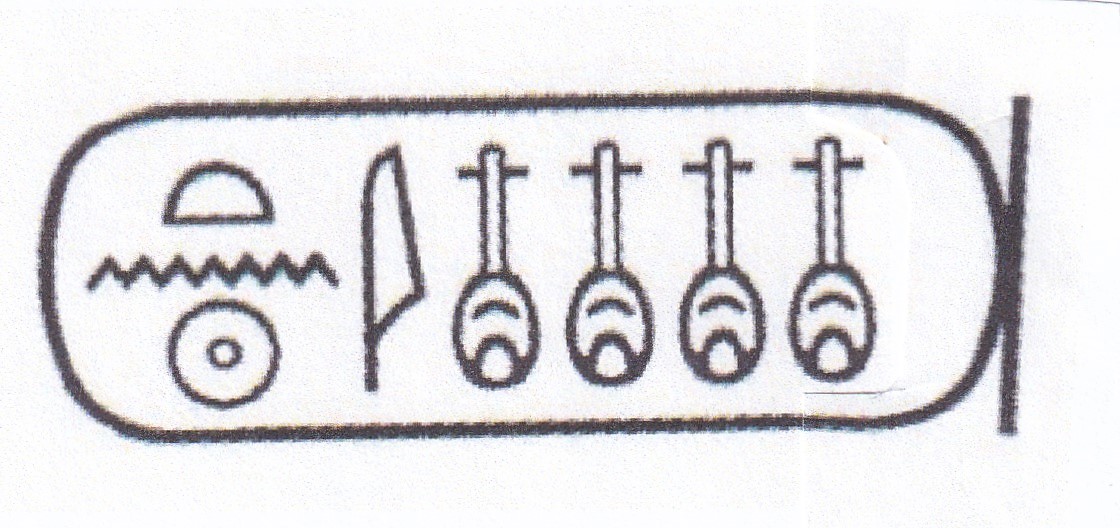
Neferneferuaten:
Glorious is the Splendour
of the Sun
 By Robin Gordon
 Auksford 2024
©
Copyright
Robin Gordon, 2024
PART V:
NEBKHEPERURE
20.
Regicide?
Auksford 2024
©
Copyright
Robin Gordon, 2024
PART V:
NEBKHEPERURE
20.
Regicide?
The successive deaths of his two first children, both of them
daughters, left the young King embittered. He was still
without
an heir, still subject to the controlling influence of his Deputy,
Horemheb, and Ay, his … well what? … not his
uncle, not
his vizier, but still somehow able to exert his will and have his own
way, except in those rare cases where he had to give way to Horemheb,
though never to his King. Tutankhamun felt that the gods had
deserted him. His attitude was bitter and expressed itself in
an
increasing habit of making sarcastic comments. This was no
longer
sporadic, now almost anything that happened, any suggestion that was
made, any possibility that was put before him, was met with sarcasm.
Ay found it extremely irritating – until he
realised that
the King’s eternal sarcasm could be the final brick in his
planned edifice of plotting.
He told no-one what he had in mind, but when he was with
Tutankhamun he always managed to bring the conversation round to the
great military exploits of the boy’s ancestors, the warrior
Kings
of Kemet, and he took special pains always to mention King
Menkheperre-Djehutymose, who had had to wait until the death of his
stepmother before he achieved greatness. It was King
Menkheperre-Djehutymose who had fought the great Battle of
Megiddo. Ignoring the cautious and hesitant doubts of his
generals, he had taken the unexpected direct route through the narrow
pass, taken his enemies by surprise and won the Battle of
Megiddo. He would have taken the great city of Kadesh itself
if
his troops had not fallen to plundering their defeated enemies.
Ay took to flattering the young King. He drew
parallels
between Djehutymose having to wait until his co-ruler,
Maatkare-Hatshepsut, died and the position of Tutankhamun, who had
started his reign as junior partner to Ankhkheperure-Smenkhkare,
another female ruler, and was now free to achieve the same greatness as
his ancestor.
“Oh, yes, with feet like mine. How is a
crippled boy
going to conquer an empire?” snapped the King, but Ay knew
that
the ambition had taken root somewhere in the secret darkness of the
boy’s soul.
The next stage of Ay’s plot was to give the young
King presents. He began with a throwing stick.
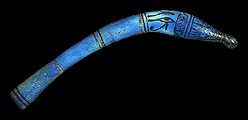
Throwing
stick
The boy banged his walking stick on the floor and muttered,
“Oh yes, I’m going to catch a lot of ducks with
that,
aren’t I? They won’t hear me stumbling
through the
rushes with my sticks, will they?”
Ay knew he practised with it in the palace garden, so next he
gave him a fine bow and some arrows.
“And just how am I going to fire a bow when I need
a
walking stick to move with? Do you think I’ve got
three
hands?” muttered the boy, but Ay learned that he took the bow
out
into the garden and fired arrows at a target while sitting on a chair.
Ay talked to him about hunting. Ay talked to him
about
battles. Ay talked to him about the Kings of Kemet crushing
their
foes beneath their heels, crushing them beneath the wheels of their
chariots, smiting them.*1
The presents continued. Ay gave the King a fine bronze sword,
and
then he heard news of a great treasure from Mitanni. It was a
dagger made of the mysterious new metal that was harder than bronze and
had been made from one of the stones that fell from time to time from
the skies. Ay sent his agents to acquire it. They
managed
to get the price down from what its owner first asked. It was
more than Ay liked to pay, but, if it achieved its purpose, it would be
worth it.
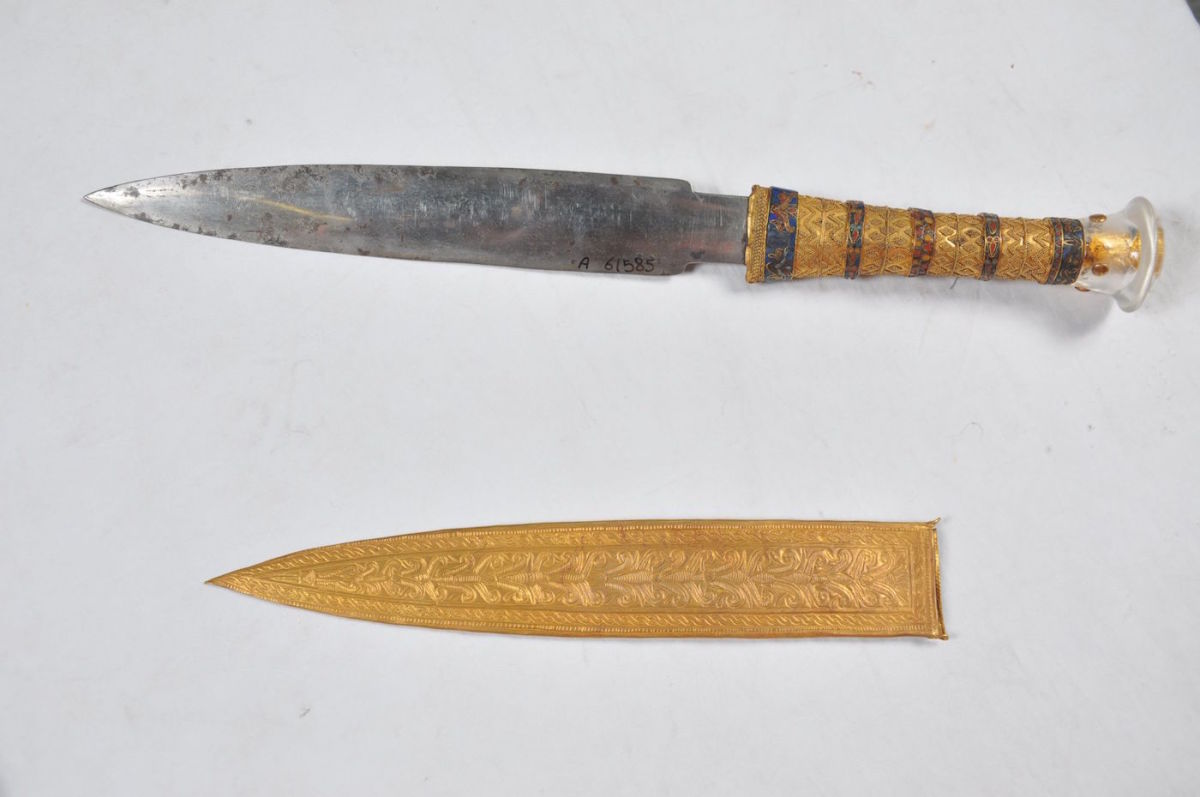
Iron
dagger
The King was delighted. Ay decided it was time to
bring out
his final gift. It too had cost him a lot, but he had so
blatantly enriched himself when the going was good that he could well
afford it. It was a box.
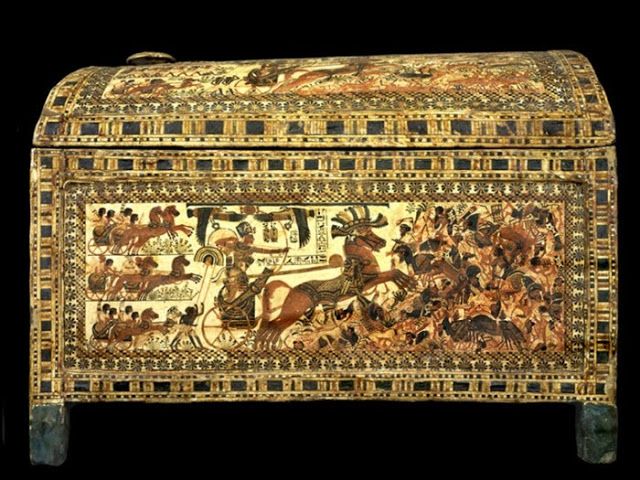
Painted
box
It was a most beautiful box, made by some of the best
craftsmen
to be found throughout the Two Lands. On the lid King
Nebkheperure-Tutankhamun is shown in two scenes where he is hunting
animals. On the ends he is shown in the form of a sphinx
treading
his enemies into the dust. On one long side he appears in a
battle against the people of Kush, and on the other he is in his
chariot firing arrows into a struggling mass of enemies.
Inscriptions on the box identify him as “the good god
Nebkheperure, the son of Re, Tutankhamun” and describe him as
“the good god, the Son of Amun, the Valiant One, without
equal, a
possessor of strength who tramples hundreds of thousands, who makes
them into a pile of corpses.”
Ay began to suggest that Horemheb wanted to keep the glory of
his
victories for himself, that, now that the King had reached the age of
reason, it would be only appropriate for him to take command of his
armies, and that he might start by joining his Commander in Chief and
learning the craft of war by watching a battle.
“Oh yes, marching along leaning on my
stick?”
“Of course
not, Your Majesty. You would have a chariot.”
“A crippled King driving a chariot?”
“… and
a driver. You would be able to watch the battle
quite safely, learn all about
strategy and tactics, so that eventually you could take command of your
armies. The glory of
the victories would then be all yours, not
Horemheb’s. You would be remembered as a new
Menkheperre.”
Eventually, as all this took root in the King’s
mind, he
decided to ask General Horemheb to take him on his next campaign
against the rebellious vassal kingdoms stirred into disloyalty by Hatti.
Horemheb refused. It was too dangerous.
Tutankhamun
was the last of his dynasty and as yet had no son to succeed
him.
His presence on a battlefield was too much of a risk.
“So,” thought Ay, “Horemheb
really is too
stupidly loyal to take advantage of what ought to seem like a golden
opportunity to grab the throne for himself.”
“Mmnngh!
I thought
this would happen,” he said to Tutankhamun.
“Horemheb quite obviously wants to win all the glory for himself and
deny you the chance of
making your mark on
history.”
The boy thought this over. He fiddled with his
beautiful
throwing stick. He stroked the hard blade of the dagger that
had
been made from the mysterious metal from the stones that fell from the
heavens. He looked at the pictures on the wonderful chest
that Ay
had given him. He saw himself, the valiant one, without
equal,
who tramples hundreds of thousands. He decided to
insist.
As King he must be obeyed, and if he decided to go to war, then to war
he would go.
Ay encouraged this new belligerence with the gift of an
armoured
cuirass, a tunic with overlapping scales of leather which would protect
its wearer from arrows and sword cuts. Ay knew that he was on
course to succeed when he saw the boy wearing his new armour to
practise sword movements and arrow-shooting in the palace grounds.
The King called his chief councillors together and made an
announcement. When the battle-season began again he would go
to
war with General Horemheb and see for himself the triumph of the armies
of Kemet over the forces of the King of Hatti. It was too
late
for Horemheb to protest. The King had spoken, and that was
all
there was to it.
Ay, standing with his fan at the right hand of the King,
immediately congratulated the boy on his courage and determination and
prophesied that he would become one of the greatest of the warrior
kings of the Two Lands.
“But,” he said, “what is to
become of
the Two Lands while
Your majesty is on
campaign. I pray you, appoint a faithful and loyal man of experience to
act as
your Deputy while both you and
General Horemheb are at war. For the sake of the people of
Kemet, I beg you to choose wisely
and appoint a man who will hold
the kingdom safe for
you.”
“You, I suppose” muttered the young King
in a tone of
deep sarcasm. Ay knew he wouldn’t be able to resist
so
tempting an opportunity for teenage wit, and he was ready.
“ME?!”
he
shouted. “Oh, Your Majesty, I had not expected you
to choose me,
but, if that is what
Your Majesty wishes, then, of course, I accept.”
Nakhtmin, warned by Ay to be ready, now began to shout,
“Oh
how wise His Gracious Majesty is to choose a loyal and experienced man
like Ay to act as his Deputy. Three cheers for His
Majesty!
Hip, hip …”
“Hurrah!” yelled the assembled supporters
of Ay.
Tutankhamun attempted to speak, but his words were drowned by
the
tumult as Ay’s supporters surrounded him with congratulations
and
continued shouting and cheering as the meeting broke up.
“I was being sarcastic,” the King said to
Horemheb,
“and now it seems that I’m stuck with Ay as my
Deputy.”
“He will have to carry out Your Majesty’s
wishes,” said Horemheb, “or he will be in trouble
when you
return.”
Ay now began the next stage of his campaign.
“Nnngh!
It is extremely
worrying that
Horemheb insists on
taking our beloved King out into
the warzone and
exposing him to danger. I must admit that, though I have
the greatest respect for
General Horemheb I cannot help fearing that some dreadful
accident may
occur in which we may lose
our King and
find Horemheb taking the throne in
his place.
“I shall, of course,
do my best to ensure the safety of
our King. I have given him a leather cuirass
designed to turn aside
any blade or arrow that
may threaten him, and I shall send General Nakhtmin to accompany him throughout the
campaign, to keep him safe from
all possible harm.
“Should Horemheb actually intend any
harm to come to
the King, which I cannot
really believe, for no-one, even
the most ambitious
of men could possibly wish any harm to come to such a
well-loved prince, but in
the event that any ‘accident’
– shee-heee-heee – should
unfortunately happen,
and if Horemheb were to come under
suspicion, at least now that I
am also Deputy to
the King, and therefore
joint heir presumptive with my colleague Horemheb, I
should be able
to challenge him and perhaps prevent
a regicide
from taking
the throne.”
As before, Ay was everywhere – temples, halls, committee
rooms,
corridors, streets, alleyways, staircases – wherever he could
meet councillors, ministers, any sort of influential person for a quiet
talk, expressing his anxiety lest misfortune occur to the King and
casting doubts on Horemheb’s motives, making it seem that the
Commander in Chief had not just agreed unwillingly but had been eager
to expose the King to danger.
Meanwhile Tutankhamun put on his new leather armour and
played at
battles with his friends, the boys who had shared his
schooling.
They used wooden swords, of course, and Ay was quite confident that
none of the boys would ever actually hurt the sacred body of
Nebkheperure, God-King of the Two Lands, Tutankhamun, Son of Re.
The young King practised in his chariot too, for, despite his
sarcastic words about being unable to drive a charging chariot into
battle, he had, like his father before him, always been keen on
chariot-driving. As a young boy he had had miniature
chariots,
and he drove safely strapped in so that he could not fall
out. He
wished now that he could drive without safety straps, but he knew that
his crippled foot made him too unsteady, and he would risk neither his
life nor the future of Kemet to prove the unprovable. That he
was
courageous and willing to learn the craft of war, that is what he would
prove as soon as the battle season started again.
Ay received daily reports, for even among the
King’s bosom
companions he had his spy, the son of a man whose advancement he had
assisted. The sword fights and the chariot-racing pleased Ay,
but
he was less pleased to hear a report that Tutankhamun had been
discussing with his closest friends the possibility of replacing Ay as
his Deputy without losing face by seeming to have changed his mind or
admitting that he had been hustled and bustled into a decision he
hadn’t wanted.
The only possibility seemed to be to class Ay as too old for the
responsibilities of governing the Two Lands, and for that they would
need to catch him out in an error of judgement or indecisiveness and
hesitancy. Ay was forewarned and he would certainly be on his
guard. As far as the King was concerned Ay would be full of
energy and absolutely indispensable.
An opportunity to show his indispensability arose quite soon.
Grave robbers were caught trying to break into the old King’s
tomb at Akhetaten. They were tried and sentenced to death by
impaling, but the risk to the royal tomb left largely unguarded in the
Royal Wadi near the deserted city was clear.
Tutankhamun was distraught.
“We must move the sacred bodies of my father and mother and
my
granny too. They should be interred in side-rooms of my own
tomb,
but it’s nowhere near ready. We must find a
temporary tomb
in the Valley of the Kings.”
“Nnngh!
Your Majesty, if you will graciously
permit me, I should like to offer
my own tomb as
a temporary resting place until
Your Majesty’s
own tomb is provided with
appropriate side-rooms.”
“And if you die before then?”
“Then
I will be buried in
my first tomb here, the one with
the fissures
in the rock that would allow water to trickle into the
tomb. When Your Majesty’s sanctified parents of glorious memory and my dearly
beloved sister Tiye are moved to
your own
royal tomb, then my
remains can be moved to
my own tomb, and,
may I say, it will be an honour indeed
for my humble akh*2
to occupy a tomb that once held such illustrious personages. Allow me to make
the arrangements while Your
Majesty prepares to join
the Commander in Chief on
the battlefield.”
The King agreed. Ay was happy. He had proved
himself
generous, loyal, decisive, and indispensable. The King would
be
off to war in a few days. There would be no time for him to
find
an excuse to demote Ay.
Ay was King’s Deputy to rule the Two Lands as he thought fit,
and
that made him joint heir presumptive with Horemheb. If the
King
did not return alive, and Ay had a strong presentiment that he would
not, and if Horemheb was blamed for his death, and again Ay felt sure
that that is what would happen, then the next God-King of Kemet would
be Ay.
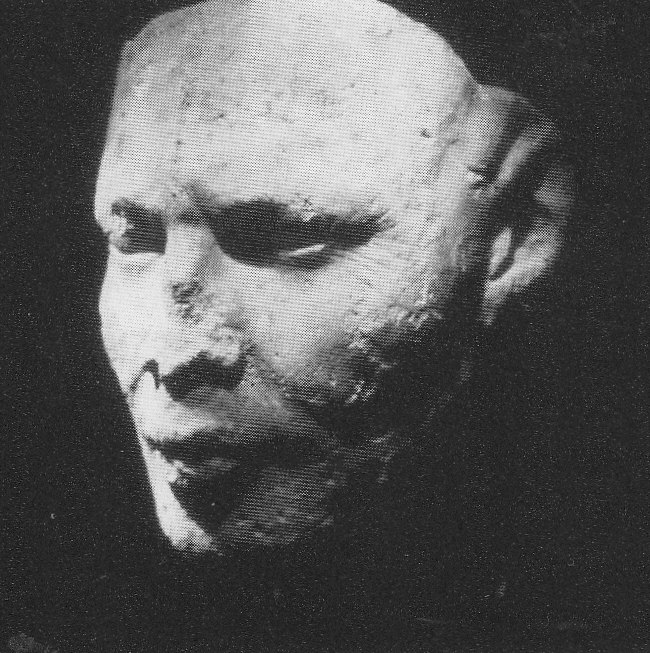 Ay
Ay
Notes
*1 Smiting them
From the time of King Narmer, who united Upper and Lower Egypt around
3,100 BC, it was conventional to portray the King as a great warrior by
showing him smiting his enemies.
Back
to text
*2 Akh
The akh was the form in which the blessed dead inhabited the
underworld. Produced by the reunion of the ka and the ba, it
was
eternal and unchanging.
Back
to text