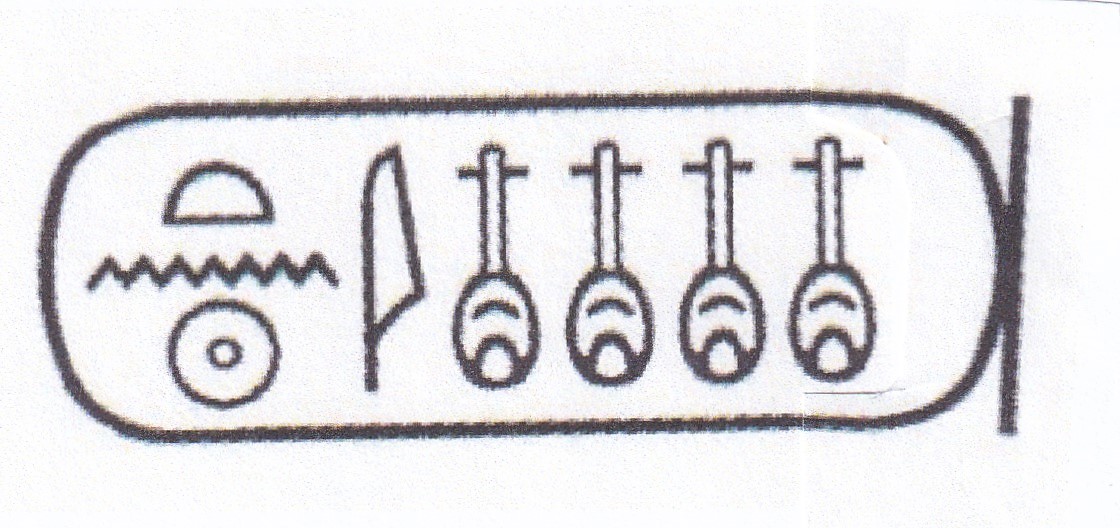
Neferneferuaten:
Glorious is the Splendour
of the Sun
 By Robin Gordon
 Auksford 2024
©
Copyright
Robin Gordon, 2024
Auksford 2024
©
Copyright
Robin Gordon, 2024
PART
III:
NEFERKHEPERURE-
WAENRE
11.
Per-Aten
Pleasure was suspended during the period of mourning for the
great King Nebmaatre-Amenhotep, but work continued. The
fields
were tilled and the crops and cattle tended, and the building of the
vast new temple at Ipet-Sut, the most holy of places, continued as
well. Taxes were collected from all the temples throughout
the
two lands, and the walls rose quickly, thanks to the new
King’s
invention of the smaller building blocks, which he said took the art of
building right back to the time of the Step Pyramid.
The First Prophet of Amun looked upon the new temple, and he
was
troubled. It was an open court, a sun temple like those that
had
been built in ancient times. Other things troubled him
too.
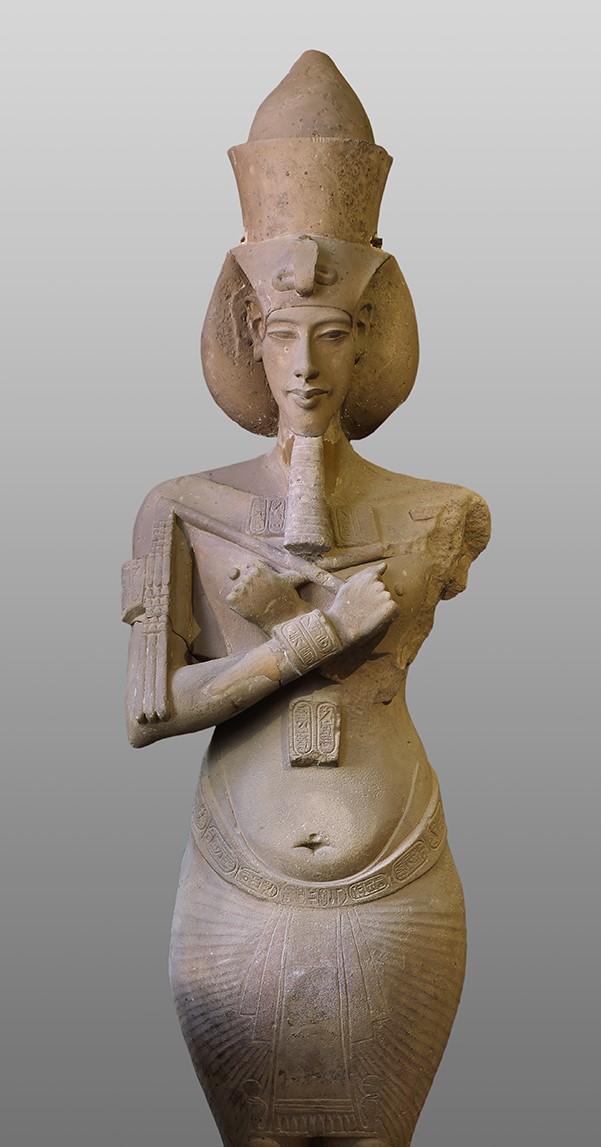
The new King, no longer subordinate to his father, had decreed a new
style of art. The statues, eight cubits high, that had been
prepared in the style of the old King, some even representing him, were
now altered to show a tall, pot-bellied, wide-hipped effeminate man
with spindly legs. Why on earth would the King –
for it was
clear these were intended to represent the King – why would
he
want to be portrayed as this deformed and ugly creature?
“His Majesty wishes to be seen as both the father and the mother of his
people,” sniggered Ay. “He has this
peculiar idea that, when you look up at him from below, he
looks noble and godlike.”
“Hideous,” said the First Prophet.
“Nnnngh!
I agree absolutely,” said Ay, “but you and I,
I’m afraid, are out
of touch with
modern views. I try
my best to
reason with
the King, but how can
one reason with
an absolute monarch who behaves like
a spoilt child. Leave it with me. I’ll do
my very
best to see that your
views receive proper consideration.”
The great open temple, which the King referred to as the
Gem-pa-Aten (the Place where the Aten is Found), was almost
compete. At four hundred and twenty-nine cubits wide and more
than eleven hundred cubits long it was larger than any other building
at Ipet-Sut. Its outer wall was about eighteen cubits high,
richly painted and protected from accidental damage by a
colonnade. On the south side the piers were adorned with
colossal
statues of the King in the new style, while on the north side the
statues were set in the bays between the columns.
“What is that supposed to be?” snapped
the First
Prophet, pointing at what appeared to be a naked effeminate man totally
devoid of genitals. “What is the King thinking of
to have
himself portrayed as a eunuch?”
“Oh no, shee-hee-hee,
that’s not
the King,” sniggered Ay. “It’s
my darling foster-daughter,
the self-styled
beautiful
one. Hee-hee-hee.”
There were more statues, all in the same exaggeratedly
elongated
style along a way that led from the west end of the temple, through the
boundary wall of the enclosure round the temple of Amun, to the
ceremonial royal palace.
“It’s too much!” raged the
First Prophet.
“What does the King think he is doing bringing these
monstrosities into the very heart of Amun’s domain.”
“Well,” replied Ay, “it occurs
to me that
perhaps creating a sun-temple
in Ipet-Sut
is the King’s way of marking
Amun’s supremacy.
After all he’s now called Amun-Re to show how
he has become the Sun-God, so perhaps this new temple will displace the
‘Greatest of
Seers’ shee-hee-hee-hee, from his place as High
Priest of the Sun, so that you can be Overseer of All the Prophets of
the Two Lands and really be the only
High Priest worth mentioning in Kemet.”
“Do you think so?”
“Well,
one never really knows what
the King is thinking, but I will certainly use every chance I get to put in a
word for
you”.
“Thank you.”
“Well, after
all, we owe our very
existence to Amun.
It was he
who inspired the Kings to drive out
the enemies who had taken over
much of
Kemet,*1
and it is from
Amun himself that
the Kings draw their authority.
“Majesty,” murmured the First Prophet and
prostrated
himself on the floor, thinking as he did so, “I am the First
Prophet of Amun, even the King should bow to me.”
“I need to speak to you about the Domain of the
Aten,” said the King. “The Gem-pa-Aten is
almost
finished, and work is well advanced on the Hwt-Benben ...”
“The Hwt-Benben?!” Why do we
need a house for the Benben Stone*2
at Ipet-sut? Ah, I see, because Amun-Re has taken over the
functions of Re-Horakhty the Benben moves here instead of staying at
Iunu.” *3
“Nonsense,” said the King.
“The Sun-God
is the Creator of the Universe. The Benben stone is here to
show
that he has taken over as chief of the gods, in fact one could say he
is the only
god, and all the others are merely aspects of him.”
“Amun is King of the gods, and all other gods are
merely aspects of Amun, even Re.”
“It is the Sun that gives us light and
life,” said
the King. “When the Sun goes down into the
Underworld our
world is bereft of life. All our people sleep and lie as if
they
were dead till light returns. Evil things enjoy the
night.
Thieves steal from beneath the pillows of the just, and the just lie
unconscious till they discover the theft next morning. The
Sun is
our Light and our Life.
“That is why I have called the new temple complex
Per-Aten,
the Domain of the Aten. That is why the main temple is the
Gem-pa-Aten. That is why the Benben is given its temple here,
and
that is why the new temples will be under the authority of the Greatest
of Seers, the High Priest of Re-Horakhty,*4
and why he, though he
resides in Iunu, will be Overseer of All the Prophets in the Two
Lands.”
The First Prophet looked despairingly towards the Fan-Bearer
on
the Right of the King, who stood a little way behind the
King’s
shoulder, and he saw expressions of disbelief, dismay, shock and horror
pass over his face.
“Your job in the immediate future,” the
King
continued, “is to see that the temples are completed in time
for
the heb-sed.”
“Heb-sed?”
queried the stricken priest.
“My father, the Dazzling Aten ... well?
“Oh! Life, prosperity, health.”
“My father planned a heb-sed for his
37th year. Plans
were well advanced, so I intend to hold the jubilee in my third year,
as expected. My grandfather held a sed for his
deceased father,
and I don’t think you’ll find our people reluctant
to hold
a festival.”
“Ah-uh” murmured the First
Prophet. It was a
vague sort of noise, but the King seemed to expect it and accept it as
agreement.
“The temples must be ready in time. The
Greatest of
Seers has many responsibilities, so supervision of the completion of
the temple complex falls to you. Everything must be
ready
to that the Per-Aten complex can be dedicated to Re-Horakhty who
rejoices in the Horizon, in his name Shu, which is the Aten.”
The First Prophet left the royal presence seething.
Well,” said the King, “I think I gave him
something to think about.”
“Indeed, yes, Your Majesty,” sniggered
Fan-Bearer
Ay. “The priests of Amun have become
far too full of
themselves. After all, it is the King who is High
Priest of all
the gods, and the First Prophet is merely Your deputy for one of the
gods.
It was about this time that Tushratta of Mitanni wrote to
Queen
Tiye complaining that her son had failed to carry out his
father’s promise to send two golden statues to Mitanni along
with
Shaushka.
“Shaushka,” snapped the King,
“failed to save
my father’s life. Why should the king of Mitanni
expect me
to reward him for his failure?”
“Tushratta is one of the Great Kings,”
said Queen
Tiye, “and a Great King such as you should always keep his
promise to his brothers.”
“Tushratta may call himself a Great King, but I
don’t
think he’ll keep his throne for long, and anyway, why should
I
reward him for failure? Wooden statues with a bit of gilding
are
all he deserves. Write to him yourself if you want, but
he’s getting nothing more out of me.”
“Well, don’t mention any of this to
Nefertiti.
She would be very upset about the way you’re treating her
father.”
Akhenaten didn’t mention it to Nefertiti, and she
had other
things on her mind, for her first child was about to be born.
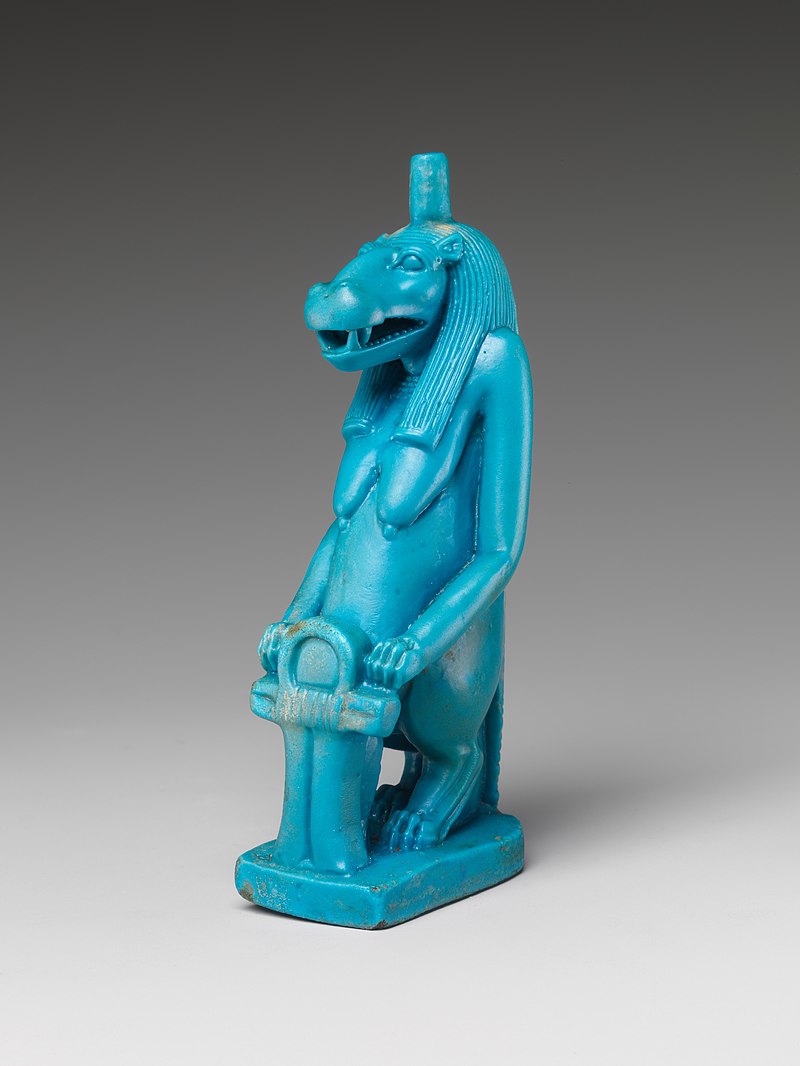
Tiye brought her amulets of Bes*5
and Taweret to bring her good luck
and said to Akhenaten that Shaushka had at least brought the
fruitfulness that King Tushratta had promised. Akhenaten just
snorted.
The first child was a girl. They called her
Meretaten, Beloved of the Aten.
The third year of the reign arrived and the heb-sed was held in
the new temple complex. Like all the feasts of Kemet it
lasted
several weeks, and the royal family moved into the palace next to the
Temple of Amun for the duration. Each day the King and Queen
processed down the avenue of colossal statues, most of them of the
King, but some of the Queen, and all in the elongated androgynous style
that Akhenaten had devised to demonstrate that the King and Queen were
divine beings, separate and different from ordinary humanity, neither
male nor female but somehow both, the father and mother of their people.
On arrival at the temple they made offerings to the Aten,
accompanied by the Greatest of Seers, while the First Prophet of Amun
and his priests looked on with unconcealed hostility. Ay was
everywhere, for he had promised the King that he would consort with the
priests of Amun, learn all he could about their attitudes and
intentions, and report back. He had also promised the First
Prophet that he would do all he could to persuade the King to honour
Amun and that he would warn him if the King intended any further harm.
The First Prophet had visited the Hwt-Benben temple, and he
was appalled.
“The Queen is shown making offerings as if she were
a King or a priest.!”
“It really is scandalous,”
said Ay, “but
perhaps we may use it to
our advantage.
It clearly shows how
devoted the King is to
my daughter,
and if he’s devoted to
my
daughter, then I
shall have a certain amount of influence with him, and
I’ll certainly put in a word
for you whenever
I can. After
all, the King must remember that it was Amun who gave his
ancestors
victory over
the Foreign Princes and drove them out
of Kemet, and it
was Amun
who gave us our empire.”
“King Nebmaatre always claimed that he was the
bodily son
of Amun, that the god took the form of his father and lay with his
mother.”
“It is Amun
who sanctifies the King and grants him the crown,”
murmured Ay.
The First Prophet grunted.
“Nnnnngh!
Your Majesty should know what I have heard
when I have been with
the priests of Amun. I am so shocked and
furious that
I can hardly bring myself to utter the sort of things they
have been saying. They say
that it was Amun
who gave Your
Majesty’s ancestors victory over the foreign
princes who ruled so
much of Kemet, that it was Amun who drove them out, and that it
was
Amun who
gave Kemet our great empire.
They say that it was Amun
who chose
your royal house to be rulers. They say that King
Nebmaatre, your illustrious father,
the Dazzling Aten
– life,
prosperity health – called himself the bodily son of Amun.
They call Your Majesty’s noble project of restoring primacy among
the gods to the Sun, the creator of all life, heresy, and I have even
heard them say that
a King who fails to worship Amun as King of the
gods is not fit to be a King at all
and that the priests of Amun
should
have the right
to depose him and appoint another prince in his
place.”
The King was furious. He commanded that all his
ministers,
all the army officers in Waset, and all the priests, should appear
before him and hear what he had to say. So great was his rage
that no-one felt his life was safe. The scribal class
assembled
in the court of his palace and threw themselves face down on the ground.
Akhenaten was almost incoherent with rage. Some of
what he
said they understood, some they didn’t.
“What I have just heard,” he shouted,
“was
worse than anything I heard last year or the year before, worse than
anything I have ever heard, worse than anything King Nebmaatre ever
heard, worse than anything King Menkheperre*6
ever heard, worse than
any King who ever wore the White Crown ever heard.”
By this time he was shouting so loudly that his words were
totally distorted by his cleft palate, so in all that assembly perhaps
only Ay knew what it was that was so bad.
Eventually the King stormed away and the assembled ministers,
officers and priests got to their feet and shambled off, each hoping
that, whatever it was that had so angered the King, would not be blamed
on him.
Akhenaten found solace in the arms of Nefertiti, and she
proposed
that they take a boat trip down the river to relax, re-establish calm
and decide what to do about whatever had so upset him. Ay, of
course, wanted to come too. Nefertiti was against
it.
Akhenaten said that Ay was the only one of his counsellors whom he
could trust.
“All
the
more reason to leave him here in Waset,” said
Nefertiti.
“Then he can tell you about anything that happens while we
are
away.”
Ay
was quite
happy with this arrangement. The King could relax for a few
days,
and his faithful Fan-Bearer would be able to tell him whatever he chose
to tell him on his return.
How
could the
King not relax on his royal barge, in the arms of the beautiful
Nefertiti? Even so he was up before sunrise looking out at
the
lands on either side of the river.
“I
have the feeling,” he told Nefertiti, “that the
Aten has something to show me,” and then he saw it.
“Look
at
that gap in the hills,” he said.
“It’s just
like the symbol for Akhet,
the Horizon.”
Nefertiti
saw a
ragged gap in the hills. It did look a bit like the sign for
‘Horizon’ now that Akhenaten had pointed it out.
Then
the Sun rose.
They
had to look away at once to protect their eyes from its glare, but the
King seemed entranced.

“It
is
the Horizon of the Rising Sun,” he crowed.
“Here I
will found my city, the city of the Aten, the City of the Rising Sun,
Akhetaten. Captain! Turn back to Waset! I
will
announce my new policy as soon as we are back home.”
Notes
*1 Enemies who had taken over
much of Kemet
During the chaos of the Second
Intermediate period
after the end of the 12th Dynasty the Delta was taken over by
immigrants from the Syria-Palestine area, ruled by Kings the Egyptians
called Hekau Khasut (the Rulers of Foreign Lands). The
Greco-Egyptian historian used the term Hyksos for these rulers. The
Kings of the 17th Dynasty, ruling in Waset (Thebes) sought to drive the
foreigners out, and this was finally achieved by King Ahmose, who is
counted as the first King of the 18th Dynasty, though he was the
brother of the last King of the 17th.
Back to text
*2 The Benben stone
The Benben represents the original mound
that rose
from the waters of chaos at the time of Creation. It is in
the
form of a pyramidon. The pyramids and obelisks were capped by
gilded pyramidons representing the benben.
Back to text
*3 Iunu
“The Pillars”, the
centre of the worship
of Re and Atum. Called in Greek Heliopolis (the City of the
Sun).
Back to text
*4 Re-Horakhty
Re who is Horus of the
Horizon.
Akhenaten’s grandfather, Thutmose IV, who had not been Crown
Prince, justified his accession in the Dream Stele, in which he
recounted falling asleep in the shade of the Sphinx while out hunting,
and, in a dream, being called by Re-Horakhty to clear the sand
engulfing the Sphinx and promised the throne of the Two Lands.
Back to text
*5 Bes and Taweret
Popular gods, not part of the great
pantheon, often
invoked for protection during childbirth. Bes was a dwarf and
Taweret an upright hippopotamus with the back and tail of a crocodile,
human breasts and the limbs of a lion.
Back to text
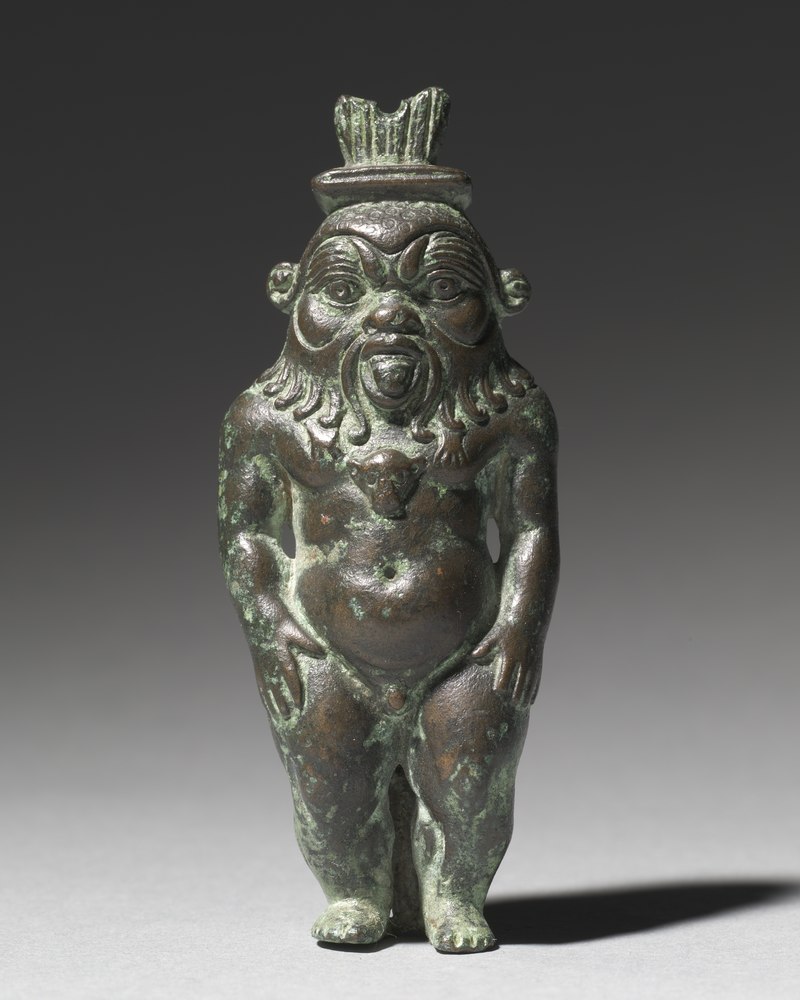
 Bes
Taweret
Bes
Taweret
Thutmose III, the greatest of the
warrior Kings of
the 18th Dynasty, Akhenaten’s great, great grandfather, and
the
victor of the great Battle of Megiddo, so famous that it gave its name
to Armageddon.
Back to text