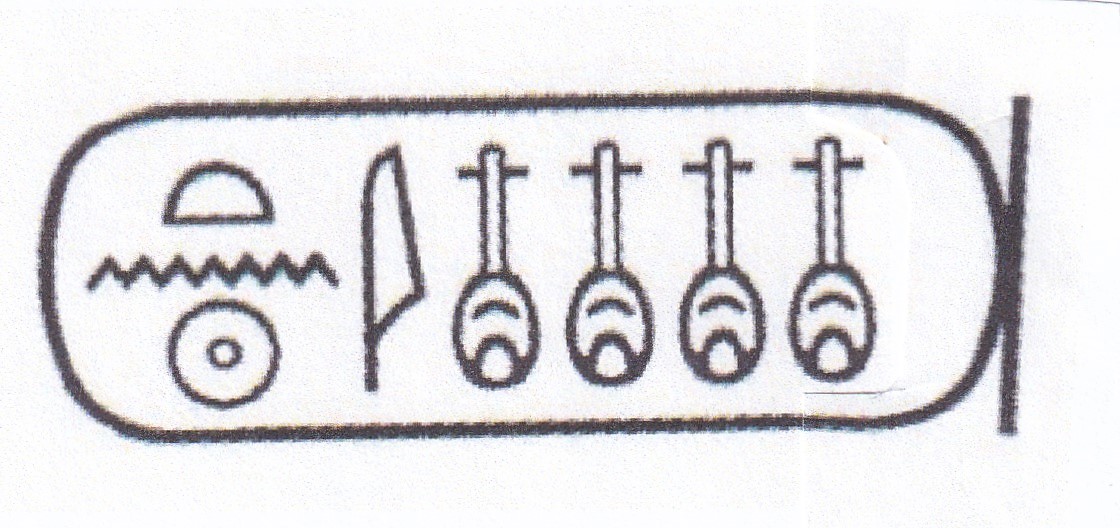
Neferneferuaten:
Glorious is the Splendour
of the Sun
 By Robin Gordon
 Auksford 2024
©
Copyright
Robin Gordon, 2024
Auksford 2024
©
Copyright
Robin Gordon, 2024
PART III:
NEFERKHEPERURE-
WAENRE
12.
Akhetaten
It was with fear and trembling that the ministers, priests and officers
heard that the King wanted them to assemble in the courtyard of his
palace again. After the uncertainty about what he had said
last
time the Overseer of the King’s Scribes positioned twenty or
so
scribes around the court and told each of them to write down as much of
the King’s speech as they could. That way, perhaps,
a
coherent whole could be reconstructed.
The fear of the assembled officials swiftly evaporated, for it was
plain that the King was in the highest of humours and excited about
some new idea that he had had.
The King proclaimed the foundation of a new city, a city that would
replace Waset as the religious capital of Kemet and Men-Nefer as the
administrative capital.
“As the
Aten is beheld, the Aten desires that there be made for him a new city
as a monument with an eternal and everlasting name,” the King
proclaimed.
“Now, it
is the Aten, my father, who advised me concerning the city, which I
shall call Akhetaten. No official has ever advised me concerning it,
not any of the people who are in the entire land has ever advised me
concerning it, to suggest making Akhetaten in this distant place. It
was the Aten, my father, who advised me concerning it, so that it might
he made for him as Akhetaten.... Behold, it is Pharaoh who has
discovered it: not being the property of a god, not being the property
of a goddess, not being the property of a ruler, not being the property
of a female ruler, not being the property of any people to lay claim to
it....
“I shall
make Akhetaten for the Aten, my father, in this place. I shall not make
Akhetaten for him to the south of it, to the north of it, to the west
of it, to the east of it. I shall not expand beyond the southern stela
of Akhetaten toward the south, nor shall I expand beyond the northern
stela of Akhetaten toward the north, in order to make Akhetaten for him
there. Nor shall I make it for him on the western side of Akhetaten,
but I shall make Akhetaten for the Aten, my father, on the east bank at
Akhetaten, the place that he himself made to be enclosed for him by the
mountain....
“I shall
make the 'House of the Aten' for the Aten, my father, in Akhetaten in
this place. I shall make the 'Mansion of the Aten' for the Aten, my
father, in Akhetaten in this place. I shall make the Sun-Temple of the
Great King's Wife, Nefertiti, for the Aten, my father, in Akhetaten in
this place. I shall make the 'House of Rejoicing' for the Aten, my
father, in the 'Island of the Aten, Distinguished in Jubilees' in
Akhetaten in this place.... I shall make for myself the apartments of
Pharaoh, I shall make the apartments of the Great King's Wife in
Akhetaten in this place.”
Puzzlement and
dismay. When he said ‘my father the Aten’
did he mean
King Nebmaatre-Amenhotep, his actual father, but if so how could he be
claiming to make a city for a dead king? Was it possible that
he
was claiming to be the son of the Sun? Why not.
Were not
all the Kings of the Two Lands called ‘Son of
Re’?
But no-one took that literally, surely. Even when King
Nebmaatre
claimed that he was the bodily son of Amun, surely that was just a
symbolic act, to secure the allegiance of the priests? But
King
Neferkheperure-Waenre-Amenhotep seemed to believe that the Sun had
called him, as Son of the Sun, to found a new capital city and move the
whole government there.
The King then
called on his officials to prepare a flotilla of boats. The
whole
government, from the viziers to the junior ministers, the senior
priests of all the most important gods, and the commanders of the army,
the whole senior administration of Kemet, would go downriver to view
the new site and have the King’s project laid out before them.
When they saw
it they were horrified. The King was planning to build a city
on
a stretch of desert. No other ruler had chosen it, no god or
goddess had taken it. Hardly surprising. It was
arid,
barren, useless – and the King expected them to leave their
comfortable homes and live in this wasteland.
The King
remained enthusiastic. He pointed out where the spine of his
city
would run, a wide royal avenue, made for chariots, that would stretch
from the northernmost tip of the city to its southern
boundary.
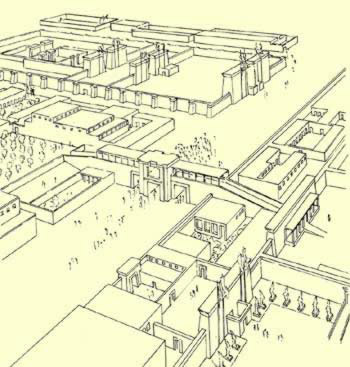
In the north would be the royal palace where the King and his family
would reside, in the south sun-temples dedicated to the Queen and the
Queen-Mother. In the centre would be the temple complex
dedicated
to his father, the Aten, the royal ceremonial palace, and the
government buildings.
There was no
stopping him. Over the next couple of years boundary stelae
were
erected, first of all delineating the city, then, as a second stage,
indicating the boundaries of its farmland on the west bank.
Taxes
were levied on the population. Money was diverted from the
upkeep
of the temples of the gods. Workmen were brought in from all
over
the Two Lands. The city rose quickly, using mud-bricks for
almost
everything to increase the building speed, with the principal temples
and palaces to be rebuilt later in the King’s new standard
cubit-sized blocks of stone.
The King and
his court made several visits to the new city. By the fifth
year
of his reign building work was well advanced. The stelae were
in
place, and his speech proclaiming the foundation of Akhetaten was
carved on them, together with images of the King and Queen and their
first two daughters, Meretaten and Meketaten. Their third
daughter, Ankhesenpaaten, was added in year seven of the reign, and by
year eight work was far enough advanced for the King and his ministers
to move permanently to the new city.
It rapidly
became a busy, bustling place. Knowing they would have to
move
the chief officials had claimed areas of land and built themselves fine
houses. Now their servants and dependents were busy building
their own smaller dwellings around their patrons’
mansions.
The King and his architects had marked out the plan of the central city
with its temples and palaces, but the building of the suburbs had
become a free-for-all. The rich claimed the best pieces of
land,
and their dependents clustered around them, forming little
villages. The southern suburb blocked the route of the royal
road, without the King seeming to notice. He concentrated on
his
great ceremonial palace, his country residence, his government offices,
his Aten temples, and his tomb, where his body would rest after the
hundreds of millions of years that the Sun would give him.
The
tomb-builders from the Valley of the Kings opposite the city of Waset
were brought to Akhetaten, and a new village built for them, east of
the city, close to the tombs they would build for the King, the royal
family and the high officials.
As for the rest
of the city, he was pleased that it was developing so rapidly and that
artisans and manufacturers of all kinds were flooding in: sculptors,
glass-makers, goldsmiths, jewellers, as well as bakers, butchers,
brewers and all the other necessary workers a great city would need.
Akhenaten explained his theology to his officials.
“All that
lives, grows and moves receives its life from the Sun. All
that
we eat and all that we have is the gift of the Sun, therefore, in this
holy place, which is dedicated to the Aten, all produce, which is his,
will be offered back to him in the temples. It will be piled on the
offering tables and given back to him by his son, the King, who alone
can speak to the Aten on behalf of the people and interpret to the
people the will of the Aten.
“It is
the Son of the Aten, the King, who will feed his people, for he is the
Mother and the Father of all who live in the Two Lands. He is
the
Universal Parent, the Provider, so, in this holy city of the Horizon of
the Rising Sun, I, the Son of the Sun, will provide for my people from
the offerings made to the Aten. After he has eaten his fill
of
the spiritual essence of the food we offer, the material remainder will
be taken by my viziers and distributed to the populace, each according
to his needs.”
“Mnnngh!
Your Majesty is most
generous, and the people of
the Two Lands should
count themselves fortunate to live under
the rule of so great
a
King.
I would be most
willing to help Your Gracious
Majesty in
distributing food to
the people of Akhetaten, for it occurs to me that
the viziers already have very wide
responsibilities representing Your
Majesty in
the governance of Kemet. They would have to delegate
supervision of
the distribution to
more junior
officials, with
the
result that Your Majesty’s intentions might not be carried out as
Your Majesty would wish.
If I, as
your faithful
counsellor, were
to organise
the distribution, this would spare the viziers extra tasks,
and ensure that
the distribution is done according to
Your
Majesty’s wishes, and
make it clear to
the recipients that their
gifts come from
Your Majesty’s gracious beneficence.”
The viziers,
unwilling to have thrust upon them what they regarded as an onerous
task incommensurate with their dignity as chief ministers charged with
governing the whole country, agreed that it would be more appropriate
for Ay to take it on, and so the King appointed Ay as the distributor
of food to the people of the city.
“What I
don’t understand,” said Nakhtmin to Ay,
“is why you
would want to take on food distribution. It’s a lot
of
work, and it doesn’t really bring you any
advantage. The
King will have forgotten your offer by next week, so what do you
gain.”
“Nnngh!
What I gain is control of
the food
supplies in
Akhetaten. I can
make sure that people who support me
get a lot of top-quality food and
people who don’t, don’t.
I think you’ll find
that quite a few very influential people will realise that it is in
their interests to keep in
with me,
sheee-hee-hee-heee!”
Ay them instructed his officers to follow these same principles.
“There’s
no need to allocate beef to building workers and other labourers.
We don’t waste good food on
people without
influence.”
“But
surely,” a scribe objected, “labourers need more
food than
people like us. They have hard physical work to do all
day.
They need
good food.”
Ay’s face paled and reddened in quick succession.
His nose
quivered. He bounced up and down on his feet.
“Is this
the sort of loyalty
I can expect from you?”
he hissed.
“When I
give instructions I expect them to be carried out without
question. I shall have you flogged, and if you
or anyone
else
questions
my orders,
well ... I’ll ... I’ll ... well,
you’d better not.
“The best
beef is to be kept for my
household and for people I
say are
deserving. People who don’t give me the respect I deserve
will have their rations cut, and as for the building workers
and such
like riff-raff,
they are of no
importance, so we give them just enough
to keep them alive and working. If they die we can easily
find
others to take their places.” *1
All was done as Ay ordered.
An architect
charged with building the smaller of the two temples, the
King’s
own family and funeral temple, pointing directly towards the royal
wadi, the break in the hills that gave the city its name, came to Lord
Ay and said, “My workers are starving.
Couldn’t you
allocate more food to them? They haven’t seen beef
for
weeks. They are too weak to work, and several have
died.”
“Mmmngh!
I am only His Majesty’s vizier,”
*2
replied Ay. My
household and I are here to carry
out the King’s wishes. It
would be most unwise to
question what the King has
ordered. I
should really go to His Gracious Majesty and put your claim to him, but
his orders are that anyone
who complains about
his allocation will have
his rations cut,
so although I would normally never
hide anything from
His Majesty, I think you’ll agree that in this case it
would be
better not
to trouble him. Then I can ensure that there will be
no cuts to
your people’s rations.”
The architect
ended up thanking Ay for his generosity. Obviously it was the
King’s fault that his workers were starving.
“Well,”
thought Ay, “if the King
gets the blame,
serve him right for not
allocating me
a tomb in the northern
group along with his special
friends. It’s a grave and serious insult.
Nnngh!
Luckily, as
controller of
the food supplies, I have enough
influence to ensure
that I get the prime
site in the southern group to
build a tomb bigger
and more magnificent than anyone else has.
Because I deserve
it!”
The King at
this time was in high good humour. He had changed his
personal
name from Amenhotep to Akhenaten, and he felt that this symbolised a
new lease of life for him, though he had not, of course changed his
throne name of Neferkheperure-Waenre, since Kings’ throne
names
are fixed forever as the names by which they are known to their people,
to their fellow monarchs and to history. Nefertiti was now
Neferneferuaten-Nefertiti (Glorious is the Splendour of the Sun, the
Beautiful One has Come).
Nefertiti had
by this time given the King four daughters, Meretaten, Meketaten,
Ankhesenpaaten, and Neferneferuaten, called after her mother and born
just a few weeks earlier. Now his secondary wife, the beloved
Kiya, who had also already given him a daughter, had borne him the
longed-for son and heir who would carry on his dynasty and his
religious reforms when he had passed from this life, for, although in
his formal speeches and in the inscriptions recording them for
posterity he spoke of a reign of millions of years, he was entirely
aware that the life of a King was no longer than that of any other man.
The city of
Akhetaten was flourishing. The temples were being rebuilt in
stone so that they would last forever, and his palaces too would be at
least partly of eternal stone. Although the officials had
murmured and muttered almost rebelliously at being made to move to the
new city in the desert, now that they had established their villas and
seen them surrounded by the smaller houses of their servants and
dependents, they seemed happy and content. They had every
reason
to be. The new city was bright and colourful, and it was
filled
with beautiful trees and scented flowers. Artisans and
tradesmen
had flooded in and built their studios. The city was a hive
of
activity and its artistic products the envy of the world.
It was time, he
felt, for a sed-festival.
It was six years since the last
one. Time to allow the people to celebrate the greatness of
their
King
Akhetaten:
the Central City
Notes
*1 Food for the
labourers
Cemeteries for the labouring classes at
Akhetaten contain bodies of young men, women, and children
that
are undernourished and with injuries to their spines and limbs, showing
that, unlike the builders of the pyramids and the royal tombs in the
Valley of the Kings, who were treated as valued craftsmen and well-fed,
the builders of Akhetaten were exploited shamelessly.
Back to text
*2
Vizier
Although very influential, Ay never held
the position of vizier.
Back to text