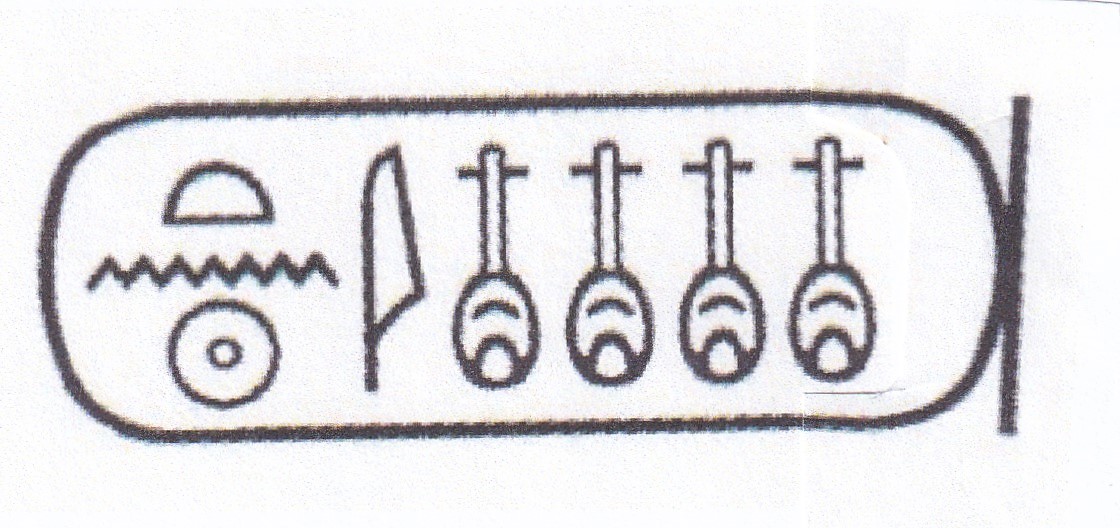
Neferneferuaten:
Glorious is the Splendour
of the Sun
 By Robin Gordon
 Auksford 2024
©
Copyright
Robin Gordon, 2024
PART V:
NEBKHEPERURE
23.
A tomb fit for a King
Auksford 2024
©
Copyright
Robin Gordon, 2024
PART V:
NEBKHEPERURE
23.
A tomb fit for a King
Accompanied by Maya, the two viziers and a number of his own
supporters, Ay made a visit to the King’s tomb in the Western
Valley.
“Mmnnnhgh!
This is entirely unsatisfactory,”
he honked. “How can we possibly bury our
beloved King Nebkheperure in
a tomb like
this. It is inconceivable that so great and
enlightened a prince
should be buried in an unfinished
tomb. I gave orders for workmen to concentrate on enlarging it, but
very little has
been achieved, and there is now not nearly enough time
to create a fitting final resting place for our King before his
funeral.”
He left space for murmurs of sorrow and horror, then began to
speak again.
“I have an idea,”
he said. “We must find a temporary resting place for the glorious akh of our
King. I therefore propose that our beloved
King Nebkheperure-Tutankhamun should be temporarily interred in my own tomb, until
this tomb of his can be made into a fitting memorial for a King of
Kemet.”
Ay’s supporters immediately applauded this generous
act of
self-denial and devotion to the late King. The viziers,
seeing no
other alternative, agreed, and, though Maya felt sure that Ay had
reasons of his own for the proposal, he could find no reasons to oppose
it.
When Ay brought this decision before the full council of the
late
King’s ministers, Maya raised doubts as to whether the
King’s sarcophagus would actually fit into Ay’s
tomb.
Ay had the measurements ready. The sarcophagus would just fit
into the burial chamber. There would not be much room left, but this
was only a temporary arrangement until the tomb in the Western Valley
could be made fit for the King.
What about the traditional four treasuries? Maya then asked:
the place of the shabtis*1,
the place of the gods, and most importantly the chamber for the shrine
for the jars containing the King’s internal organs and the
statue
of Anapau to keep guard over them. Two more weeks, at least,
would be needed to create them. Ay was persuasive.
The
burial in this small tomb was not to be the King’s last
resting
place. Treasuries were not needed for such a temporary
arrangement. Maya tried to insist. Whatever else
was left
out, he said, there must be a treasury to hold the King’s
internal organs under the guard of Anapau.
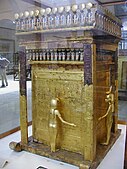
Tutankhamun's
canopic shrine
The
council
compromised. One treasury would be dug. Its
principal use
would be to house the King’s internal organs and a statue of
the
god Anapau, but other treasured possessions of the late monarch might
also be placed there, including his shabtis, the bodies of his two
stillborn daughters and the precious lock of the hair of his
grandmother, Queen Tiye. Ay was satisfied. One
chamber
could be excavated in the time he needed to complete the
King’s
funeral and have himself crowned before the return of Horemheb.
Maya had another objection. The King would require
the four traditional shrines.
“They can be added later,”
said Ay, “when the
King’s body is moved to the Western Valley.”
Maya insisted that the shrines were needed at once to ensure
the
King’s reanimation. The innermost, a symbol of the Per-Nu
or House of Flame, recalled the shrine where the King had received his
crown. Without it he might not be recognised as King in the
Afterlife and the Sun-God Re might have to travel without one of his
principal warriors. Not to provide the shrine might risk the
destruction of the Sun. The second and third shrines had
similar
symbolic meaning. They represented the Per-Wer, confirming
the
death of the King, his status as one with Usír, and assuring
him
the protection of Hwt-Hor, while the fourth shrine would have the
Seventeenth Chapter of the Book of the Dead. Without that
text
the deceased could never be recognised as one with Usír, able to
enter the Afterlife and, as a King of Kemet, take his place in the
Barque of Re to help defend the Sun against the vile serpent Apep.
The priests of Re, the priests of Hwt-Hor, the priests of
Usír and the priests of Amun all concurred.
Without the
shrines the sacred akh
of King Nebkheperure-Tutankhamun would be
unrecognised and undefended, and the result might well be that the
world would be condemned to eternal darkness, that all living creatures
would die, and the waters of chaos swallow up the whole of the Earth
and return it to its state before Re called forth the lotus and the
Benben stone.
Even Ay was alarmed. “I am sure that there is
enough
room in
the temporary tomb for
the shrines that will protect our
beloved King,”
he slurped. “Now that I am aware of
the significance
of the shrines – and I am sure that you will
all
understand that as
an active administrator with all the
responsibilities of
government that have fallen on
my shoulders as
Deputy to
his late Majesty I may have temporarily forgotten the
importance of
certain artefacts associated with
the funeral rites in
my anxiety to ensure that
our King is laid to rest in
the most
appropriate manner so that his akh
may be eventually transferred to
a
truly grand
tomb as befits so beloved
a monarch – I will most
certainly see
to it that the shrines and all other necessary pieces of
funerary equipment are
provided.”
General Nakhtmin applauded. “Well said,
Lord
Ay,” he grated. “I for one am sure that
your
arrangements are first class!”
Prompted by this Ay’s other supported nodded and
murmured agreement.
The carpenters making the shrines were not best pleased when
they
saw the burial chamber. They measured it and they went to the
sculptor’s studio to measure the sarcophagus again.
There
would, in principle, be room for the shrines to surround the
sarcophagus, but the question was, how were they to be installed when
there was so little room?
The only practical way they could see was for the North, East
and
West Walls of the shrines to be brought in before the sarcophagus was
installed and propped up against the walls, first the outer shrine
walls, then the second and third, and finally the inner
shrine.
The South walls and the roofs would have to be stored in the
antechamber, and the carpenters would have to climb over the
King’s sarcophagus to fix the shrines into position, no
matter
how disrespectful that might seem.
If the shrines had to be stored in the burial chamber, then,
of
course, the jars containing the King’s digestive organs, the
statue of Anapau, the shabtis, the coffins of his daughters and other
treasures must first be installed in the Treasury as soon as it was
fully excavated, and the other funerary goods would have to remain at
the Temple of King Nebmaatre-Amenhotep until the shrines were completed
and the antechamber clear to receive them.
This was all reported to Ay, and he approved the
plan. Then
he commanded that a painting job be done on the tomb as soon as it was
finished, including a scene of himself performing the Opening of the
Mouth ceremony.
The painters absolutely refused and so did the
plasterers.
“Our work will be damaged beyond repair, totally ruined if
these
heavy wooden shrine walls are leaned against it,” their
overseer
told Ay’s secretary. “We will have to
paint the
scenes after the shrines are built, and that is going to be very
difficult in such a confined space. We are not going to be
able
to do the sort of work you’d expect in a royal
tomb. The
pictures will have to be large scale and quite crude.”
“The Lord
Ay will not mind as long as it is done quickly,” said the
secretary.
“That will suit the painters,” replied
the
overseer. “They will hate working in such a
place.
There will scarcely be room to get their arms up to paint at all. And
as for seeing the results – well, they’ll do their
best. They all loved the late King.”
“Oh well,” sniggered Ay, “even
if the painting
isn’t perfect the gods
will understand its significance”
“And”
he thought to himself, “that
will prove to them the I
am the rightful King.”
*2
Ay’s agents continued making frequent visits to the
tomb,
where the workmen were excavating the new treasury, to the
coffin-makers, to the sculptors engaged in carving the quartzite
sarcophagus, and to the embalmers working on the King’s
body. All seemed to be progressing with the speed that Ay had
ordered, except that the sarcophagus carvers seemed to be falling
behind. Ay himself paid a visit to the sculptors’
studio.
“Will the sarcophagus
be ready in time?”
he demanded.
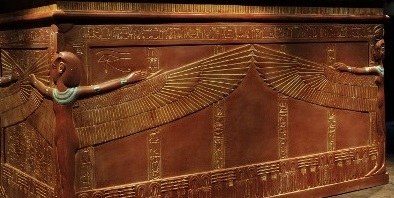
Tutankhamun's
sarcophagus
“Of course, my Lord, “said the chief
sculptor.
“We have this sort of thing down to a fine art.
Forty-eight
days to make the sarcophagus itself and then another twenty for the
lid, leaving two days to make any adjustments and install the
sarcophagus in the tomb ready to receive the body.”
“Is this
the kind of loyalty
I can expect,” raged
Ay. “I told you the whole job had to be
finished ready for
the King’s funeral in fifty-five
days. Now you tell me you
have allocated seventy
days. I shall have you dismissed from your
post.”
“Seventy days is the time allotted for preparation
of the
body,” protested the sculptor. “All will
be ready for
the deceased …”
“The King
had a preliminary
embalming on
the battlefield,”
shouted Ay. “You were told this and that I expected
the
sarcophagus to be ready for a funeral in fifty-five
days. You
have only
a few days left.
What still needs to be done?”
“The sarcophagus is ready,” said the
sculptor,
“but we have only just started on the lid. That
will take
at least twenty days.”
“Not
good enough, Ay ranted. “Aren’t
there any suitable lids
that you could adapt?”
“No, my Lord.”
“Let me
inspect your workshop!”
Ay found am almost complete stone lid.
“Use that,”
he ordered.
“My Lord. It is made of red sandstone, completely
unsuitable for a sarcophagus of golden quartzite.”
“Use
it!”
“But, my Lord, it is a flat lid, and we need a
domed lid for his late Majesty.”
“Use
it!”
“My Lord, there’s a crack in the
stone.”
“It will be hidden inside shrines inside a sealed
tomb. No-one will know
there’s a crack. Use it!”
“But …”
“USE IT!! Any further obstruction and
I’ll have
you flogged and replaced as
Overseer of the Sculpture Workshop.
I’ll have your hands
cut off. You’ll never be able to
work again. You’ll have to beg in the
streets. USE
IT!!”
“Yes, my Lord.”
The time had come. Ay ordered the diggers to be
cleared out
of the treasury. It wasn’t painted but that was of
no
consequence. The workers left, harried by Ay’s
scribes,
without even having the time to clear away the last load of
rock-chippings.
Ay ordered the treasury to be packed with whatever had to go
in
there. Maya objected. The King’s internal
organs in
their jars contained within a decorated chest should be carried in the
funeral procession. So too should the gold cow’s
head and
the statue of Anapau. Ay insisted. The temporary
tomb was
too small to allow for much in the way of ritual and
ceremony.
The jars, the head and the statue, together with the coffins of
Tutankhamun’s daughters and his other treasures, had to be in
position before the sarcophagus was installed, and the sarcophagus had
to be in position for the funeral. The haste, it was plain,
was
because Ay had by this time persuaded most of the court that Horemheb
had murdered the King in order to secure the crown for himself, and
that only by completing the funeral ceremonies and crowning Ay before
Horemheb’s return could the Two Lands avoid being ruled by a
regicide. Those like Maya who did not believe it were shouted
down. The treasury was filled and then the walls of the
shrines
were brought in and stored in order against the North, East and West
walls of the burial chamber. The South walls and the roofs
were
placed in the anteroom ready to be installed was soon as the
King’s body was safely enclosed in his coffins and
sarcophagus.
Good news came to Ay. Nakhtmin had succeeded in
ambushing
Zannanza, who, believing that he was on his way to marry the dowager
Queen and that all of Kemet was set to welcome him, had travelled
swiftly with only a small escort. Nakhtmin sent envoys to
meet
him. They brought him greetings from the people of the Two
Lands,
and also an invitation to dine with their commander, who would then
escort the new King to Kemet with the full panoply of royal
honours. The unarmed Hattians were than slaughtered at the
feast
and buried in the desert.
Ankhesenamun sickened in despair, and Ay decided that when
she
died she should be buried with her mother, Nefertiti. That
reminded him that there were in store unused funerary bands named for
Ankhkheperure-Neferneferuaten, which had not been used because the
Queen regnant had been buried as Ankhkheperure-Smenkhkare.
There
would be no time to rework the names, but still some of them could be
used for Tutankhamun. After all, no-one would ever see that
his
corpse was wearing someone-else’s bands, and so some of the
rather beautiful and highly expensive trappings made on
Maya’s
orders might be laid away and renamed for the funeral of the next King,
Ay the Doer of Right, the Upholder of Justice, the Maintainer of Maat.
Notes
*1 Shabtis
The shabtis (also called Ushabtis or Shawabtis) are miniature figures
of the deceased. They may be made of clay or
faience. Their
function was to act in place of the deceased if he were called on to
perform any task in the Afterworld. As a King Tutankhamun was
provided with a worker shabti for every day of the year, plus overseers
and senior overseers.
Back to text
*2 The painting of Ay
performing the Opening of the Mouth ceremony for Tutankhamun
The Opening of the Mouth was traditionally performed by the eldest son
and heir of the deceased and was regarded as a ceremony confirming his
right to succeed to his father’s position. No other
King’s tomb contains such a scene. Was Ay trying to
prove
to the gods that his succession was legitimate by including this scene?
Back to text