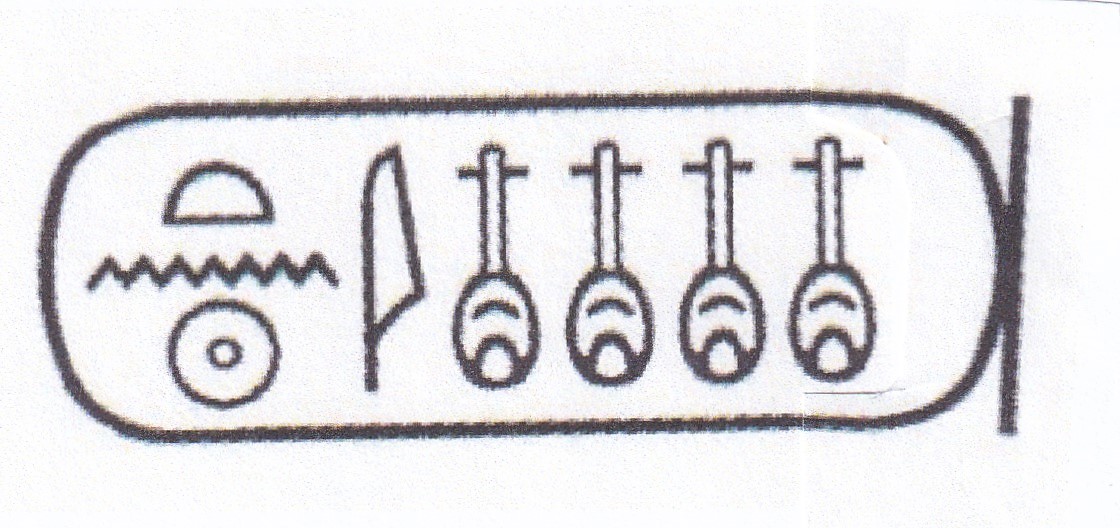
Neferneferuaten:
Glorious is the Splendour
of the Sun
 By Robin Gordon
 Auksford 2024
©
Copyright
Robin Gordon, 2024
PART V:
Auksford 2024
©
Copyright
Robin Gordon, 2024
PART V:
NEBKHEPERURE
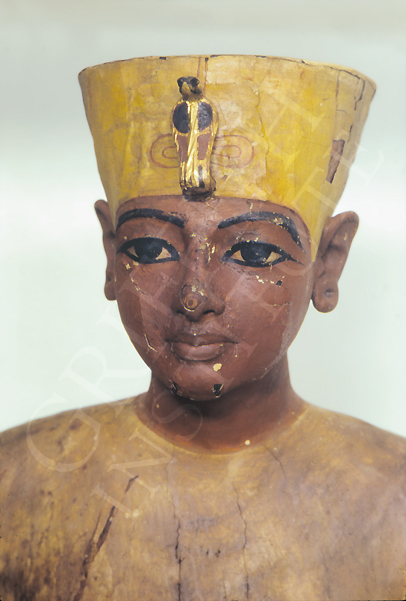 19.
The Boy King
19.
The Boy King
It had all been written out for him by Ay himself, and all
the
boy had to do was read it aloud at the meeting of the
council.
Because he was the King the notes Ay had written for him were not on
old potsherds but on a strip of expensive papyrus, but because they
were working notes they were written in the more cursive script used
for everyday business rather than the beautiful formal script used in
temple inscriptions. This was easier to write and also easier
to
read, but still Ay had gone through it several times with the
boy. He might be a king, he might be King of the Two Lands,
but
he was still only a child, he had to obey his elders, and Ay wanted to
make sure he was word perfect and could read the proclamation without
any hesitations or mistakes. The proclamation was important
to
Ay, probably the most important document he had ever had to deal with.
“I, King Nebkheperure-Tutankhamun, King of the Two
Lands,
hereby proclaim that, because, when a child comes to throne the
King’s mother acts as regent, and because death has robbed me
of
my beloved stepmother who ruled alongside me, have determined to
appoint one of my most faithful counsellors to rule as my Deputy, with
full powers to act in my name and to take whatever measures he deems
appropriate to the governance of my kingdom, and he shall hold these
powers throughout the Two Lands. I have further determined
that,
to avoid any doubts as to who shall inherit the throne should I die
before a son is born to me, my Deputy shall become heir presumptive and
shall take over as King, unchallenged by anyone, should the need arise.
“I have considered carefully the merits of all my
counsellors and have decided that, because of his loyal service to my
stepmother, my father and my grandfather, my choice must fall on the
Lord Ay, and I therefore appoint the Lord Ay hereditary prince and
King’s Deputy, with full power to rule the Two Lands in my
name.”
When he came into the room the counsellors all fell on their
faces and abased themselves before their King. The boy bade
them
stand, announced that he had a proclamation to read, and
began.
He was word-perfect as drilled by Ay.
He did not look up from his papyrus. If he had he
would
have seen Ay smirking and squirming with satisfaction and delight,
while his followers watched him, realised that he was going to be given
new powers and readied themselves to rush forward and congratulate
him. He would have seen his viziers, Usermontu and Pentju
looking
increasingly worried. He would have seen Maya, Overseer of
the
Treasury, looking at Ay and scowling. He would have seen
Horemheb, the Commander in Chief of the Army and his generals all
looking grim, except for General Nakhtmin, who had a lopsided,
anticipatory, voracious grin.
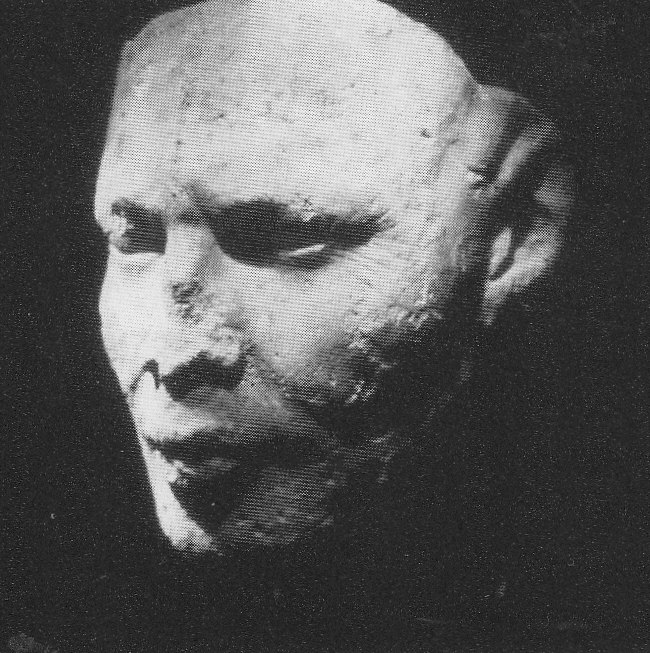
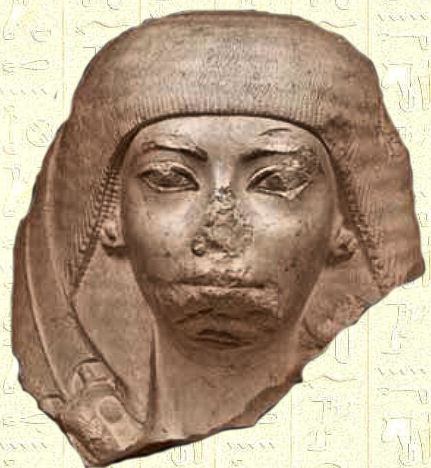
Ay
Nakhtmin
Tutankhamun came to the end of the first section.
His voice
squeaked a little as he began the next section.
“I have considered carefully the merits of all my
counsellors and have decided that, because of his loyal service to my
stepmother and my father, my choice must fall on the Lord Horemheb, and
I therefore appoint the Lord Horemheb hereditary prince and
King’s Deputy, with full power to rule the Two Lands in my
name.”
“Mmmnnnngh!”
gasped Ay.
Horemheb’s mouth fell open in shock.
Then the generals, except for Nakhtmin, hurried to
congratulate
him, and Maya bowed before the King and thanked him.
King Nebkheperure-Tutankhamun then went back to his private
quarters, where his beloved sister, Ankhesenamun awaited him.
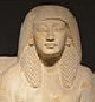
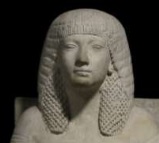
Maya
Horemheb
To the fury of Ay the newly appointed Deputy to the King
began at
once a series of reforms.*1
He redefined and strengthened the
functions of the viziers of Upper and Lower Kemet, he authorised
transfer of funding from the temples of the Aten back to those of Amun
and the other traditional gods and encouraged the restoration of the
temple precincts, which had fallen into neglect during
Akhenaten’s reign, and, worst of all as far as Ay was
concerned
he appointed judges to look into the abuses that had grown up over the
years and in particular to enquire into the activities of the
tax-collectors, making it impossible for Ay to continue diverting royal
revenues into his own coffers.
The only advantage to Ay in all this activity was that
Horemheb
was often away from court. Ay was always present and able to
slime around the young King, praising him, flattering him, boring him
with his constant presence, so that Tutankhamun would often give him
whatever he asked for, sometimes because he was pleased with the
flattery and sometimes to get rid of him so that he could play with his
friends. He sometimes even preferred his lessons to the
society
of Ay. In fact some were extremely interesting, especially
the
history of the Two Lands and the deeds of his ancestors and
predecessors as King.
Then Horemheb persuaded the young King to leave Akhetaten and
take up residence in the House of Rejoicing, formerly the House of the
Dazzling Aten, the palace complex built by his grandfather, King
Nebmaatre, where his beloved grandmother, Queen Tiye, had
lived.
The royal household, the King, his family, his tutors and his servants,
would reside there, close to the religious capital, Waset, but much of
the business of government would return to the old administrative
capital of Men-Nefer in the north. Had Horemheb decided on
this
to thwart Ay? Ay was sure that was his motive. No
longer
could the elder statesman be constantly with the King and at the same
time on hand to interfere with the Council of Ministers and overthrow
with his persuasive tongue decisions that he disliked. Now he
had
to make a choice each time and travel back and forward between the two
centres of power while Horemheb imposed his own will by decree.
With thoughts on the afterlife and the King’s
ultimate duty
of aiding the Sun-God in his nightly struggle against the serpent Apep,
work was started on a royal tomb in the Valley of the Kings.
Horemheb himself, thinking about his future afterlife in the Field of
Reeds, was constructing a magnificent tomb in the traditional
necropolis for nobles at Saqqara, close to Men-Nefer.
Ay already had
a magnificent tomb at Akhetaten, but he now realised that, if the city
were totally abandoned, tombs there would be unprotected and almost
certainly looted by grave-robbers. He was growing
old.
Surely he had not enough years left to create another equally splendid
tomb at Saqqara. In the absence of time to create
magnificence he
needed to settle for something more modest but in a holy place
–
the Valley of the Kings. He began at once to petition the
young
King, until, at last, the boy gave him a site. It
wasn’t in
the best position, not at all what he thought he deserved, but he had
to accept and set his men to work on it.
When he came to
think about it, even if the tomb were not in the best of prime
positions, it was, at least, in the Valley of the Kings, and that
assured him of a secure and privileged position in the
Afterlife.
As for this present life, his position was unassailable.
While it was
true that he could no longer enrich himself on the scale to which he
had become accustomed, he had, over the years, built up so much
wealth*2
in land, in gold and silver, in stores of grain, and in the
gratitude of those to whom he had been such a generous patron at the
King’s expense, that he could live more than comfortably,
purchase whatever he needed or wanted, and rely on the support of his
grateful clients and retainers.
Most people
accepted that he was the brother of the late Queen Tiye. He
was
regarded as an elder statesman, and, although he had no official
position as a vizier or similar high official, he had, over the years,
made himself so indispensable as an intermediary between King, viziers,
ministers, priests, generals and indeed everyone of any importance,
that anything he said was regarded as having the full authority of the
person to whom he attributed it.
A word from Ay
was regarded as a word from the King, and, since Horemheb, as a
diligent Commander in Chief of the Army, was often away on campaign
among the rebellious vassal kingdoms, whose rulers had been accustomed
to quarrel among themselves without any interference from the King of
Kemet, and who, with the encouragement of the King of Hatti, saw the
accession to the throne of a mere child as an opportunity to free
themselves from the empire, Ay had the freedom to act as if it were he
who was Deputy King.
He had good
reason to be completely satisfied with his life, but he
wasn’t. He had set his heart on becoming a god, and
the
only way that he could see to do that was to become King.
Tutankhamun was growing more and more crippled as the bones of his foot
deteriorated. He relied more and more on his walking sticks,
and
the constant pain, and perhaps even more, the humiliating knowledge
that he could never be a warrior king like so many of his greatest
ancestors, meant that he was often ill-tempered and apt to fly into
violent rages.
When Ay
discovered that his new tomb had been excavated in rock with fissures
through which damp could penetrate, he immediately went to the King to
petition him for another tomb. Tutankhamun allocated him
another
site, but Ay complained that it was low down near the valley floor and
not suitable for an elder statesman of his eminence, one who had served
under four Kings (counting that
woman). The boy flew into such a
rage that Ay was afraid he would work himself into a seizure and
die. That was not at all what Ay wanted. Horemheb,
the
King’s Deputy would succeed, and that would be the end of
Ay’s influence. There was only one person who could
calm
the King when he was in such a state: Horemheb. Luckily he
was in
the palace at the time. Ay sent a servant to find him.
Horemheb’s
presence seemed to bring calmness to the King. Tutankhamun
talked
quietly to his general, and Horemheb indicated to Ay that he had better
accept the King’s offer and sound grateful for it.
Ay
slimed, squirmed, slurped and sniggered, and the King forgave
him. What Ay could not understand was why Horemheb did take
such
care to calm the King, when it was to his advantage for the boy to die
before he had any children. Horemheb’s attitude was
a
mystery.
The King was
growing up. For Ay this was inconvenient.
Tutankhamun was
no longer the little boy content to leave business in the hands of his
elders. He wanted to rule. He wanted to be King and
to be
seen to be King. If he disapproved of Ay’s policy
he said
so and had it changed, and, like many other teenagers, he became
addicted to sarcasm to show his disapproval. Poor old Ay, his
most faithful counsellor, had to accept rebukes in the most sarcastic
of tones, but he still could not get rid of the boy because then
Horemheb would be King.
The boy was
growing up. He was old enough to father a son, and so
eventually
Ankhesenamun was pregnant. On the whole Ay was
glad.
Horemheb had missed his chance. He should have taken the King
off
to war and arranged an accident. After all, despite his
increasing lameness, the boy still liked to think of himself as a
warrior king like his great ancestors. When the baby grew
into a
toddler, passed the dangerous age of early childhood, that might be
time for Ay to act. With the King dead the little prince
would be
heir with his mother as regent, and Ay had no doubt that he would be
able to manage her.
Horemheb seemed
happy with Ankhesenamun’s pregnancy. He
congratulated the
King and his sister-wife with apparently genuine pleasure, almost as if
he had no designs on the throne at all. Either he was an
absolute
fool, thought Ay, or a hypocrite so clever that even Ay himself could
not fathom his deceit.
The pregnancy did not come to term.
Ankhesenamun
suffered a miscarriage. The child was a girl. She
was
mummified in the usual way and placed in a gilded coffin, but not
interred in a tomb, for her father’s tomb was still in the
course
of construction. The coffin was laid in a storeroom, with due
reverence, to remain there until the first of the child’s
parents
died.
Horemheb seemed
to share the King’s distress, and assured the boy that he
would
have other children. It was only because he and his wife were
so
very young that this pregnancy had come to such a sad end.
Wait
awhile, then try again.
Ay still could
not understand what Horemheb was planning. He must surely
have
arranged for the Queen to be given an abortifacient so that he would
still be heir presumptive. Perhaps he was waiting for Ay to
die
before he murdered the King, but Ay would not die. On that he
was
determined. When the crippled King finally joined his
ancestors
in the Afterlife, Ay would be the one to succeed him.
Ankhesenamun at
last was pregnant again. Ay watched carefully, determined to
find
out what Horemheb intended to do and to thwart him. This time
Ay
would not wait. He would act as soon as the baby was
born.
Whether boy or girl it would automatically become the King’s
heir, so Ay would make his move. He would begin to flatter
the
King’s desire to be seen as a great warrior. He
would
persuade him to demand that Horemheb take him on campaign.
Then
he would arrange for an accident and contrive to blame Horemheb for the
King’s death. That would leave him as the most
powerful man
at court. Ankhesenamun would be Queen Mother and Regent, and
firmly under his thumb. He would make her designate him
King’s Deputy and heir presumptive, and then the baby would
suffer one of those mysterious cot-deaths that carried off so many
little children, and, soon after, Ankhesenamun herself would die of a
broken heart, and Ay would be God-King of the Two Lands.
The weeks went
by. Ankhesenamun was near her time – and Horemheb
was
called away to put down another rebellion. Ay’s
plan was
well on its way to success. Then, suddenly the Queen was
taken
with dreadful pains. The midwives were called.
Prayers were
offered to Taweret and Bes. All was in vain. The
baby,
another girl, was born dead.
Ay could not
understand how Horemheb had managed it. He was hundreds of
miles
away. He must have had a loyal servant with access to the
Queen
– unless it were true that he was such a fool that he was
genuinely loyal to the anointed King. If that were so
… if
that were so … it might well prove to the advantage of Ay
– but for the moment he was thwarted again. If the
King
died then Horemheb, as Deputy and heir presumptive, would take the
throne, and that would be the end of Ay’s ambitions.
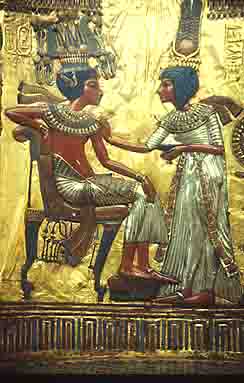 Tutankhamun & Ankhesenamun
Notes
*1 Reforms
Horemheb’s reforms were
carried out in the
name of the King and recorded on a stela issued as if it came from
Tutankhamun.
Back to text
*2 Wealth
Ancient Egypt did not have
money. Workers were
paid in bread, beer, beef and grain; taxes were paid in kind; and the
rich held land, property, and precious items.
Back to text