Neferneferuaten:
Glorious is the Splendour
of the Sun
 By Robin Gordon
 Auksford 2024
©
Copyright
Robin Gordon, 2024
PART VI:
KHEPERKHEPERURE
27.
The Doer of Right
Auksford 2024
©
Copyright
Robin Gordon, 2024
PART VI:
KHEPERKHEPERURE
27.
The Doer of Right
. “It was pretty obvious to anyone who
kept his eyes
open that it was Ay who was determined that Tutankhamun should go to
war,” Maya had said. Among those who had their eyes
open
and were in a position to observe Ay’s machinations were
Queen
Ankhesenamun’s companions, handmaidens and ladies in
waiting. Ay had sent them packing. Back at home
they told
their sisters what they had seen and heard, they told their mothers,
some told their brothers, a few told their fathers, and they nearly all
told their friends. Their friends told their sisters and
their
mothers and talked about it all with other friends. Those who
had
servants talked with their maids, and the maids told their sisters and
their mothers and their friends. Some of those friends were
maidservants to richer families, and they told their mistresses.
Knowledge of Ay’s hidden treachery spread through the female
population of the Two Lands. The women knew that it was Ay
who
had urged the young King to go to war, that it was Ay who had held up
before him the prospect of being a great conqueror like his famous
ancestors, and that it was Hormeheb who had been reluctant to expose
him to danger. They knew about the expensive presents Ay had
bought Tutankhamun to persuade him that his destiny lay in
battle. They knew about the magical iron dagger made from
metal
thrown down to earth by the gods, and they knew about the famous chest
with its scenes of the King in his chariot defeating the fleeing troops
of his enemies. They knew too that it had been
Nakhtmin’s
task to accompany the King, and they suspected – and passed
round
their suspicions – that Nakhtmin might even have been the
King’s murderer.
They knew, too, that Ay had told Ankhesenamun that he would become King
and that he would marry her to strengthen his claim to the throne, that
Ankhesenamun blamed him for the death of Tutankhamun, and that it was
the Queen herself who had written to the King of Hatti in a desperate
attempt to avoid being married to a man who was not only old enough to
be her grandfather but also responsible for the murder of her
beloved husband.
When Ay made his great speech, in effect blaming Horemheb, the women
decided that it was time the men knew what they knew.
Maya and Paramessu had never believed Horemheb guilty of
anything. They had always been sure that the death of
Tutankhamun
had been plotted by Ay and carried out by Nakhtmin. Now they
found many others were ready to share their opinion, especially as it
became more and more apparent that the rule of Ay, the self-styled Doer
of Right, was a rule by gangsters.
Under the bullying incompetence of General Nakhtmin the army had lost
many of its best officers, despite the pleas of Paramessu that they
should stay on and resist the decline. They had all been
replaced
by cronies, friends and acquaintances of Nakhtmin. The army
now
behaved like an army of occupation and took from the civilian
population whatever it wanted. Soldiers who needed leather
for
new armour took cow-hides from farmers by force. Soldiers who
wanted beef for a feast might take a whole cow. The farmers
resented the looters, so that sometimes a troop returning to the
riverside with their booty would find that their boat had
disappeared. Locals disclaimed all knowledge, so, if they
could
not steal another the ill-disciplined soldiers would have to walk home,
perhaps even abandoning some of the spoils of their raid.
Then the tax-collectors would arrive, no longer Maya’s
well-ordered civil servants but a motley crew of less than honest
scribes working under the control of Ay’s agents and filling
their own storerooms as well as the King’s. They
had the
old tax-records to hand and knew how many cattle a farmer had had the
previous year. If he claimed to have lost some, either
slaughtered or dying from disease or old age, they demanded the
hides. If no hides could be produced the farmer’s
wealth
was assessed as if he had the same number of cattle as before, and he
was taxed accordingly. This was the way Ay rewarded his loyal
followers, and the poor farmers and workers were the ones who paid for
the lifestyles of the newly rich.
That the tomb of Tutankhamun was robbed could not be blamed
on
King Ay. Tomb-robbery was a fact of life – or a
fact of
death – and had been since the earliest days of burials with
expensive grave goods. Still, when Maya, in his capacity of
Overseer of the Tombs in the Valley of the Kings, reported to King Ay
that thieves had broken into his predecessor’s tomb, grabbed
what
they could in the anteroom, ripped silver and gold fittings from the
furniture, and left in a great hurry, and that he and his deputy had
had their workmen seal up the tomb and fill the entrance passage with
rock chippings to deter future thefts, he thought that Ay had a rather
peculiar look on his face as he congratulated the team on their
efficiency and promised that the guards would be rewarded.
“It wouldn’t surprise me,” he
said to his wife,
if that sniggering hypocrite were to send a gang of robbers
himself.”
Meanwhile Horemheb was living as a quiet country gentleman,
concentrating on running his estate at Hansu. He and his
wife,
Amenia, had given up hope of having a child, but, to their surprise she
became pregnant again, and this time he hoped the child would
live. Prayers were sad to both Bes and Taweret, but all was
in
vain. Amenia died in childbirth and her child died with her.
Ay was delighted. “Nnngh!
This proves that the gods are with me
and look with disfavour on all those who obstruct me, sheee-heee-heee.
They are almost all dead
now and forgotten, including that
woman who dared to take the crown for
herself when it should have come to ME. Now
Horemheb’s wife is dead
too, shee-heee-heee-heee.
A just punishment. He was responsible for taking our
beloved little King to war, and
he would have grabbed the throne if
I hadn’t got there first. Well,
Horemheb will be occupied for
the next few weeks in mourning for his wife and preparing for her
funeral. Now is the time for me to appoint Nakhtmin as my heir.
“Mnnngh,
Nakhtmin, I’m going to
arrange a little expedition that will be very profitable,
and I think you will find it amusing.
That interfering busybody, Maya,
will, of course, attend the funeral ceremonies for his
friend’s wife,
and I think I can keep him occupied in Men-Nefer for
quite a long time, so I think now
would be a good time for robbers to
break into the brat’s tomb – but this time they will
be men who know exactly
where to look for
the most precious jewels – sheee-heee-heee-heeee!
“After all, I
am King now, so the whole
country and
everything in
it all belongs to ME,
so if some
tomb-robbers handed over
their spoils to ME
they would be restoring them to
their rightful
owner. They would be restoring maat, shee-heee-hee-heeee!
Maya found himself suddenly overburdened with work.
The
King commanded him, as Treasurer, to compile a full report on the state
of the Treasury, and this involved him spending most of his working
hours in Men-Nefer, the administrative capital of the Two
Lands.
His duties as Overseer of the royal tombs had to be left to his deputy,
Djehutymose, and his efficient and well-disciplined troop of
guards. What he did not know was that the King then commanded
his
deputy to attend him and be on hand at all times for detailed
discussion of his tomb, which was coming on well in the western part of
the valley, near the tomb of King Nebmaatre.
Some meetings were held in the tomb itself, where Ay pointed
out
that, because he was already an old man and unlikely to live much
longer, he had commissioned large-scale paintings, similar to the those
he had ordered for Tutankhamun. The facts that the tomb had
originally been intended for the late King, that his burial in
Ay’s private tomb was intended to be temporary and that Ay
had
promised to complete the western valley tomb for Tutankhamun and
transfer him and his parents and grandmother there, these were never
mentioned. After all, a King of Kemet was a god, and no-one
ever
challenged his orders.
Most of the time, however, the Deputy Overseer, Djehutymose,
just
hung about in the King’s palace, waiting to be called if the
King
ever needed him.
Meanwhile the troop of guards in the Valley of the Kings,
without
anyone from the scribal class in charge, were delighted to receive a
reward for their efficiency in protecting the tomb of King Nebkheperure
– a very generous amount of beer. After a few
beakers they
didn’t feel in the least like going out on patrol, and after
a
few more they wouldn’t have been able. They lay
around,
drinking and talking, and singing when they felt like it, and
eventually they went to sleep.
This left the thieves plenty of time to break into the tomb,
and
they needed it. They broke open a hole near the top of the
outer
door. Then they had the laborious task of tunnelling through
the
limestone chippings that Maya had used to fill up the entrance
tunnel. That took them all night, but they came
back the
next night and were still undisturbed. The guards had
received
another reward. Again they had taken a beaker or two of beer
to
fortify them for their patrol, then another and another until they felt
too comfortable to leave their barrack, so they stayed and drank some
more, while the thieves got on with their work.
Once inside
they knew exactly where to look for precious and easily portable
booty. One went to the annexe, where the precious perfumes
were
stored and began to fill the wineskins they had brought, while the
others broke through into the burial chamber and from there into the
treasury. They had not much time left before dawn, so they
grabbed just a few things and left as quietly as they had come.
They knew full
well that the guards would be rewarded again for their vigilance, and
so
they returned the next night. This time they got away with a
load
of gold and jewels from the treasury and wineskins full of unguents and
perfumes from the annexe. There was more to be taken, and
they
knew that the guards would receive yet another reward the next night.
Ay was
delighted with the success of his plan. The tomb-raiders
handed
over the royal share and were allowed to keep a share for themselves.
“Why don’t you take the lot?” Nakhtmin
asked. “I would.”
“I have a
reason to want to
recover some of
these valuables wasted in
burying
that brat,” said Ay, “and it’s not because I want
to
have lots of
pretty jewellery for
myself. I use it to buy
friendship and
support, to bribe people to
do what I want them to
do. These fellows are rewarded for bringing my share of the
loot
to me, so they’ll go back again and again until
there’s
nothing left worth taking, and with Maya and Djehutymose out of the
way, there’s no
likelihood of
their being caught,
shee-heee-heee-heee.”
As it turned
out Ay had made one small error. He had called Djehutymose
away
from his duties before Maya had got very far on his journey.
Djehutymose sent a messenger after him. Maya abandoned his
journey. He sent one of his secretaries on to Men-Nefer to
instruct the Treasury scribes to begin compiling the report demanded by
the King, and he hurried back to the Valley of the Kings. His
deputy, meanwhile, stayed with the King and was very obviously on hand
in case he should be needed.
The guards of
the royal tombs were rewarded again the next night, and again the
thieves set about their plundering with no fear of being interrupted,
but this time Maya was in charge, and the thieves had only begun their
work when the guards appeared. They fled in confusion,
dropping
the stuff they had grabbed including a linen cloth on which one of them
had slid several precious rings for easy transport.
The guards pursued them. A couple were caught and beaten on
the
soles of their feet until they named their accomplices.
“You
can’t punish us,” said one of them.
“We have
been sent by the King himself. He’s the one
we’re
taking the jewellery to.”
By this time
Djehutymose had slipped way form the King’s retinue and
joined
Maya. They discussed what was to be done. Clearly
public
execution by impalement on a wooden spike was out of the question, and
probably too the rounding up of the other members of the
gang.
The two they had caught would be quietly killed with a sword, the tomb
tidied up as quickly as possible, the tunnel refilled with stone
chippings and the door resealed. No mention of the robbery
and
its discovery would be made to the King, and discretion would probably
prevent him making any inquiries in case his own part in the crime
should come to light.
The guards went
into the tomb and tidied up as quickly as they could, stuffing loose
items into nearby chests. They were unable to read and
therefore
took no heed of the inscriptions and labels. Some remained on
guard duty for the rest of the night while the others returned to their
tents to sleep. The next day those who had slept brought
stone
chippings and filled the robbers’ tunnel.
Djehutymose left
his name inside as a witness to his presence, then hurried back to join
the King’s retinue. Ay was by this time aware that
his gang
had been disturbed. He sent Djehutymose to the Valley, where
he
and Maya resealed the repaired door with their seals. Maya
then
left for Men-Nefer and Djehutymose reported that the guards, full of
guilt and remorse at having neglected their duties in the absence of
their superiors, had gone out on patrol, disturbed the robbers, pursued
them and killed two. The identity of the others was unknown,
he
said.
“Mmnngh.
This is highly
unsatisfactory,” said Ay. “These
wicked miscreants
must have got away with
quite a lot of
our beloved
King’s most precious possessions, and
there’s nothing we
can do about
it.”
To Tey and
Nakhtmin he said, “It’s a very satisfactory state of
affairs. I’ve got a substantial amount of the most
valuable
jewels, some of which can go into my own tomb when the time
comes, and
no-one can connect me to
the robbers at all. I think that’s
a job well
done.”
Ay chose the
day of Amenia’s funeral to announce that he had adopted
Nakhtmin
as his son and heir with the titles of Hereditary Prince and
King’s Son of His Body.
When the news
reached Horemheb and his friends they were far from pleased.
It
was already known, thanks to Ankhesenamun’s ladies, that it
was
Ay who had manoeuvred Tutankhamun into going to war against the wishes
of Horemheb, it was known too, thanks to Maya, that Ay had organised
the robbery of Tutankhamun’s tomb. It was suspected
by many
that Nakhtmin, officially there as the young King’s escort
and
protector, might possibly have killed him, and now that he had become
Crown Prince it was certain that the corruption and maladministration,
the creaming off of the country’s wealth into the hands of
Ay’s cohort of cronies, and the thefts from farmers and
craftsmen, that had been expected to end with Ay’s death,
would
continue, perhaps for another thirty years.
The people were
impoverished. Farmers were taxed on wealth they no longer
owned,
on cattle that had been stolen by bands of soldiers, and on crops that
had been trampled in the thefts of cattle. There was no point
in
hard work to increase their herds and harvests. They were
just
working to provide extra loot for the raiders. Craftsmen and
traders were losing their goods to thieves. The temples of
the
gods, though re-established by decree of King Nebkheperure, felt
impoverished. Their income was reduced by the impoverishment
of
the farmers and traders who would have provided them with cattle and
crops, and the calls on them to assist the population were increasing
all the time. The First Prophet of Amun and the Greatest of
Seers
were among those who had hoped that Ay would be succeeded by Horemheb
and corruption would be ended.
Like Paramessu
and the former military officers the priests were appalled at the idea
that Nakhtmin would succeed to the throne. Then, by a
circuitous
route, there came to the circle around Horemheb, news that confirmed
their suspicions about Nakhtmin. It seemed that a shepherd
boy
had been hiding from the battle between Horemheb’s troops and
the
Apiru, and he had seen a young man dressed like a King thrown from his
chariot, then the chariot return and run over him, and then, and this
the shepherd had found most mysterious, the driver had deliberately
wounded his horses.
An officer who
had been with Horemheb’s army then remembered that, after the
King’s death, Nakhtmin’s horses, chosen for their
calm
temperament to pull the King’s chariot, had become very
nervous
and particularly afraid of Nakhtmin. There could no longer be
any
doubt that Nakhtmin had murdered Tutankhamun, and that it was Ay who
had organised the assassination.
Ay meanwhile
was riding high. He was King. His adopted heir
would be
King after him. His network of cronies were as loyal as ever,
and
he had received so much of the gold and jewels from
Tutankhamun’s
tomb that he could reward such loyalty generously and ensure that no
disloyalty would ever disturb his contentment. As a bonus,
his
arch-enemy, Horemheb, had lost his beloved wife of so many years and
was in a state of such desolate bereavement that he would be unlikely
even to think of moving against the Doer of Right, as Ay now called
himself.
It was
true. Horemheb was desolate. The love of his life
was gone,
and he had nothing left to live for. Paramessu urged him to
marry
again. He felt that was unthinkable, though, as the months
passed, he began to find consolation in the company of a chantress of
the god Amun and of the goddess Hwt-hor, and eventually she became his
wife.
It was about
this time that General Nakhtmin, Hereditary Prince, King’s
Son of
his Body, Commander in Chief of the Armies of the King of the Two
Lands, disappeared. Had he died of plague while out on
campaign? Had he been killed in battle? That would
have
been extraordinary for a commander in chief, but such was
Nakhtmin’s incompetence that it was possible. Had
he
perhaps been murdered by soldiers under his command, infuriated by his
bullying manner and lack of strategic and tactical ability?
Or,
as Ay suspected, had he been assassinated by agents of Horemheb?
He consulted
the First Prophet of Amun. Parennefer assured him that Amun
and
the whole pantheon of gods would know who was responsible for any
murder, and that anyone who killed a King or his heir, no matter how
successfully he had hidden his crimes during his life, could not escape
their vengeance. All deceased men and women would stand
before
Usír for the ritual weighing of their hearts, with Djehuty
to
record the verdict. The heart of the deceased would be
weighed
against the Feather of Maat, the Goddess of Justice and daughter of the
Sun-God Re. The innocent would pass into the Field of Reeds
as
beloved subjects of Usír, King of the Underworld, but the
hearts
guilty would be thrown to Ammut, the Devourer. She would
gobble
the heart, condemning the guilty one to everlasting death.
“Nnngh!
Nnnngh! Mmnnnnnghh! Um …. Yes. So, um
… if
Nakhtmin
was murdered, mmmmgh,
the killer would be condemned … by the
gods. There would be … er … no escape, I suppose
…?”
“No,
indeed, Your Majesty. Any murderer would be condemned by the
weight of his guilt – and the heart of the murderer of a King
would immensely heavy. There is no possibility of escape for
him,” said Parennefer, noting with interest Ay’s
failed
attempts to conceal his dismay.
Ay consulted
the Greatest of Seers and was given the same advice: anyone who
murdered or encompassed the murder of a King or a crown prince would
pay the price when he was led by Anapau before the God of the Dead,
Usír. The weight of guilt on his heart would far
outweigh
the Feather of Maat. His heart would be thrown to Ammut, the
Devourer. She would gobble it and he would be totally
destroyed.
“Take comfort, Your Majesty. The Weighing of the
Heart will bring you justice.”
Ay
did not take
comfort. He consulted the High Priests of Ptah,
Usír, Hor,
Iset, Hwt-hor, Sobek and other gods, and all told him the same thing.
The feast of
Opet approached, when the god Amun would visit his wife Mut and renew
the life, strength and fertility of the Two Lands and of their
King. Ay’s strength seemed to ebb away as the days
passed. The First Prophet urged him to name his
successor.
Ay hesitated, prevaricated and demurred. Parennefer suggested
that, since Ay no longer had an heir, he should nominate the heir
presumptive of his predecessor. Perhaps the gods had not
approved
of his taking the throne himself. Kemet had not prospered
under
his reign. Perhaps if he nominated Horemheb the gods would
look
on him with favour when he came before them.
Perhaps
there
was a chance. After all, he hadn’t actually killed
anyone
with his own hand. Ay named Horemheb his heir.
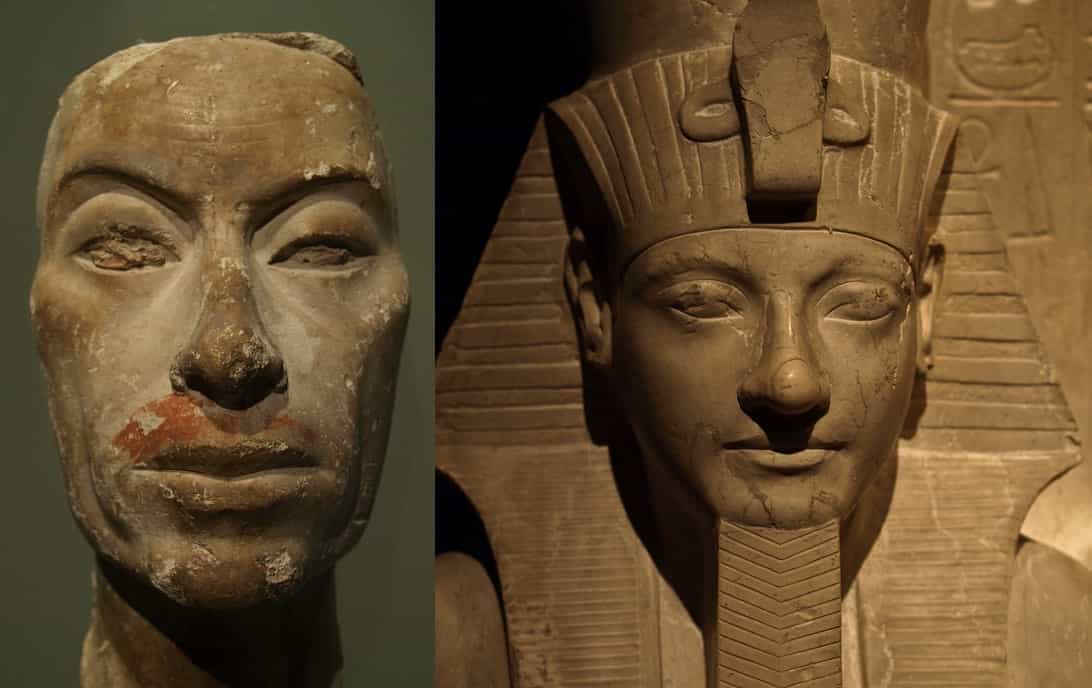 Ay
and Horemheb
Ay
and Horemheb