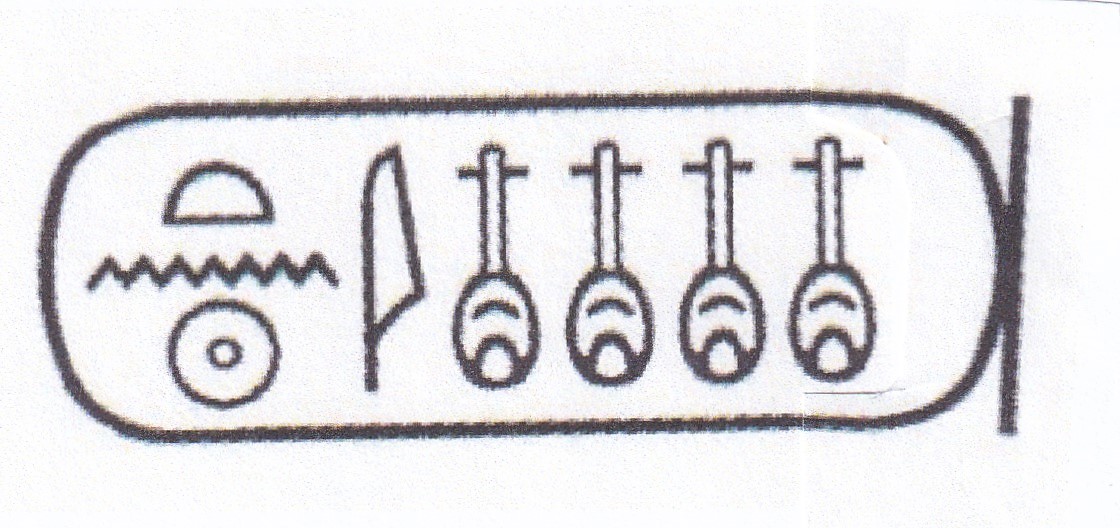
Neferneferuaten:
Glorious is the Splendour
of the Sun
 By Robin Gordon
 Auksford 2024
©
Copyright
Robin Gordon, 2024
PART II: NEBMAATRE
10. The
Falcon has flown
Auksford 2024
©
Copyright
Robin Gordon, 2024
PART II: NEBMAATRE
10. The
Falcon has flown
The new young King was full of energy and eager to start his
co-regency. Ministers and advisers were rapidly appointed,
most
of them, as was traditional in Kemet, the sons of his
father’s
ministers.
It was not long before he summoned the First Prophet of Amun
to his apartments in the palace complex.
“To the east of the great temple of
Amun,” he said,
“there is a vast mudflat with no building on it. My
father,
the Dazzling Aten ...”
“Life prosperity, health” murmured the
priest.
“Indeed,” continued the young King,
“he has
built many great things at Ipet-Sut. It is my intention to
build
an even greater temple on that empty site so that the gods may have all
the honour due to them.”
“Your Majesty is most kind, most
generous,” said the priest.
“I have then your support for the collection of
taxes and the diversion of temple income?”
“Of course, Sire. I will today instruct
the Second
Prophet to make generous provision from the estates of Amun for this
noble project.”
“In the meantime,” said the King, I will
continue
work on the latest gateway to the temple which my father the Dazzling
Aten ...”
“Life, prosperity health.”
“... started but has not yet finished.
“Too kind.” and the First Prophet went in
considerable delight to tell his priests that the Young King was even
more generous to Amun than his father had been – and this was
no
faint praise, for King Nebmaatre-Amenhotep had built on a larger scale
at the holy place of Ipet-Sut than any previous monarch. The
accession of King Neferkheperure-Waenre-Amenhotep heralded even more
wealth and influence for Amun, King of the Gods.
The First Prophet was less pleased when, some time later, the
Young King called him in again and instructed him to lead an expedition
to the quarry at Kheny.*1
He protested, as far as one could protest against the decree of an
all-powerful god-king, pointing out that, while supervisors from the
scribal class were always essential, it was unheard of for the First
Prophet of Amun to be assigned such a task. The King merely
replied that the great temple would be the biggest ever seen at
Ipet-Sut and that a project of this importance demanded the attendance
of the High Priest. Specialist scribes, used to the work of
quarrying, would accompany him and carry out the necessary supervision
of the quarrymen, but his presence would emphasise the importance of
the task.
The Young King then went on to speak in excited tones of the
size
of the temple, the construction of which would be expedited by his new
idea. In the past, while temples and other monuments were
measured in cubits, they were built of massive blocks that varied
considerably in size. The bold new idea was that each block
quarried in Kheny should be one cubit long and half a cubit wide and
deep. These new blocks would be much more easily carried by
the
builders and the temple might then be complete by the time of King
Nebmaatre’s next heb-sed
in three years’ time.
The First Prophet found himself agreeing that this would be
wonderful and that the project should, after all, be under the
supervision of a senior priest, and so, on the orders of the King, he
sailed upstream to Kheny with the King’s scribes and spent
several weeks living in cramped and uncomfortable accommodation
–
at least by his standards – watching the supervisors as they
instructed the quarrymen and recorded the number of blocks
extracted. His contribution was minimal. He had
nothing to
do. He was bored, and he could not understand why the King
required his presence there.
On his return he was even less enamoured of the
project.
The temple would not be the traditional closed building with an inner
sanctum, accessible only to the priests, where the golden image of the
god dwelt and was attended each day. It would be a vast open
space, like the temples of the Sun God from the far-off old times, and
the Young King often referred to it as the House of the Aten, the
Sun-Disc.
At about this time the Old King sickened, and it became
obvious
that he was near to death. His vast tomb was already
well-prepared and fully decorated. Grave goods began to pile
up
in the storerooms of the palace, everything the King could possibly
need in the afterlife, from chariots of electrum to loaves of bread,
from weapons of war to jars of wine, from jewellery and amulets to
statues of the gods.
Then one day Queen Nefertiti was awakened by the sound of
wailing.
“The falcon has flown,” a weeping servant
told her,
“and the falcon sits in his place.”
Amenhotep explained. “The falcon has
flown”
meant “the king is dead” and “the falcon
sits in his
place” meant the new Hor replaces the old and the line of
kings
goes on.
Queen Tiye and her daughters appeared with dishevelled hair
and
ashes on their heads, wailing as if inconsolable.
The body of the King was laid on a bed with heads of Sekhmet,
the
Lion Goddess who protects against disease and other evils, decorating
its supporting sides, and his ministers filed past to pay their last
respects, followed by the palace servants, from the highest official to
the lowliest kitchen maid. Nefertiti saw the Fan-Bearer,
General
Ay, Priest of Min and self-styled brother of the old queen and father
of the new, and she noted the smug triumph on his face, and remembered
how he hoped to twist “King Honky” round his little
finger.
Messengers were sent out to take the news to Waset and the
other
cities, for a time of mourning was upon the Two Lands. It
would
take seventy days to prepare the King’s body for its resting
place in the tomb, and during that time no-one would drink wine or eat
meat, no one would bathe, and no-one would have sex. People
would
weep in the streets, and messages of condolence would come from the
other great Kings, his brothers, though none would be as heartfelt as
that from Tushratta of Mitanni, who would rather have lost half his
people than his dearest friend.
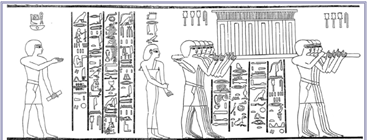
When the time came the body was placed in a sarcophagus of
papyrus stems and carried down to a boat of a kind Nefertiti had not
seen before.
“It is the neshet,
the boat of the god Usír,” Queen Tiye explained,
and the
women whom you see here are professional mourners. They are
called the Kites of Nebet-Het. A procession of boats followed
the
neshet
until it landed again
on the west bank of the river. There a group of male dancers,
wearing wreaths of papyrus crowned with caps like the Hedjet
or White Crown, met them and by nodding their heads and gesturing with
their hands made them welcome and assured them that the spirits of the
necropolis would gladly admit the deceased King.
His body in its casket of papyrus stems was carried ashore,
the
Kites of Nebet-Het danced and wailed, then two of them, representing
(as Queen Tiye whispered to Nefertiti) the goddesses Iset and her
sister Nebet-Het) began to recite the Lament over Usír,
for, (as Queen Tiye explained), the King, who had once been the living
Hor, was now Usír.
A bull was led forward and sacrificed under the supervision
of
the Kite who represented Iset, then the casket containing the body was
raised onto the shoulders of a group of men.
The
procession
set off, led by a censing priest, while the pallbearers chanted,
“Let his son, Hor, hand his enemy over to him, and let the
crown
of his justification before the gods be presented to him.”
The
Kites of
Nebet-Het followed them, with the Queens and the young king and his
sisters, and behind them came servants carrying grave goods, the
treasures and everyday objects that would accompany the King to the
world of the dead.
The
King’s body was taken into his funerary temple and handed
over to
the embalmers. His grave goods were taken into another part
of
the temple, and, while this was happening, the royal family and the
senior officials held a banquet to remember the King’s life.
Seventy
days of
mourning now began. No-one bathed, had sex, ate meat, or
drank
wine. Citizens wept in the streets for the loss of their
King,
and they wept sincerely, for few Kings of the Two Lands were as loved
as Nebmaatre-Amenhotep.
Then came the time of his funeral. The royal
family, the
viziers, the ministers, the senior priests and army officers, and
crowds of ordinary men and women congregated on the west bank of the
river near the King’s funerary temple and watched as the sem-priests*2
brought out his open coffin and loaded it onto a sledge.
Inside
lay the body of the late King, preserved by long soaking in natron and
now wrapped carefully in swathes of linen bandages wherein lay precious
amulets to guard him on his journey.
On another sledge were loaded four jars. These
contained
his internal organs, removed through a small slit in his side, so that
they would not decompose inside his body and ruin it. He
would
still need them in the afterlife, so they too were preserved and would
be taken with him to the tomb. His brain was of no account
and
had been thrown away, but his heart was preserved and lay in its usual
place inside his chest. His heart was the seat of his
being. It would speak for him before the gods, and it would
be
weighed against the feather of Maat, goddess of justice, at his
judgement before Usír. The Justified, judged
True-of-Voice, would proceed to the Field of Reeds to continue their
life for eternity, but the King would enter the Barque of Re and travel
with the Sun God, helping to defend him on his journey through the
hours of darkness and to ensure that the sun would rise again and
restore life to the world.
Grave goods of all kinds were piled on sledges drawn by oxen,
but
when the procession moved off the King’s sledge was pulled by
the
viziers and other senior ministers. They had a heavy load to
draw, for the King’s coffin was of solid gold.
Wailing
women, the Kites of Nebet-Het, followed, lamenting wildly.
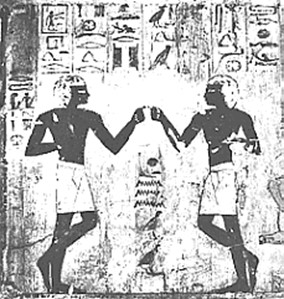
At the entrance to the valley they were met by the Muu-dancers,
and these guided the procession, now no longer followed by the crowds,
for ordinary people were not allowed into the sacred necropolis.
The route of the procession included short visits to symbolic
areas within the valley representing places of cultic importance,
including Sai, the site of Usír’s grave, the holy
city of
Abdju, and Per-Wadjet, the home of the Cobra Goddess who protected the
Lower Kemet. Then it continued to the western valley and the
King’s tomb, where it was greeted by two Muu-dancers,
His-Face-Before and His-Face-Behind, who wore no caps but danced
bareheaded to welcome the deceased.
The coffin was unloaded and leaned against a mound of sand so
that the mummy of the King and his magnificent gold and jewelled mask
could be seen, and the main ceremonies began. Lamentations
were
sung, including again the Lamentation
over Usír,
sung by two of the Kites of Nebet-Het. Libations were poured
and
the priests called on Usír and Djehuty to seize the
King’s
enemies that he might be freed from them and reborn. Incense
was
burned before the King, and the priests chanted the names of gods who
had gone to the Underworld with their kau*3
or spirits. They called on the King to go with his ka, and chanted,
“The arm of your ka
is before you, the arm of your ka
is behind you, the leg of your ka
is before you, the leg of your ka
is behind you.” The King is united thus with his ka, and the Eye of
Hor symbol displayed to him to ward off evil.
Cold water and two pellets of natron were then offered,
followed
by five pellets of natron from the south and five more from the north.
Sem-priests
approached the mummy and held before the lips of the golden mask two
stone fingers. Queen Tiye explained to Nefertiti that they
represented the fingers of the midwives which would symbolically clear
the airways of the reborn King of mucus and allow him to breathe the
air of the Underworld. Another approached and held before the
lips a pesesh-kaf,
the knife with which the midwives cut the umbilical cord.
“You must breathe and take food on your
own,” they
chanted, “for you are now born into the Afterworld of
Eternity,” and they offered two bottles, one empty, one
containing milk, representing the breasts of Hor and Iset. A
soft
cake was then offered to the reborn King.
Then the priests offered him five cloves of garlic, followed
by a hard cake and some wine.
“The King is now reborn,” said Queen Tiye
to
Nefertiti. “He is given milk and soft food, then
the cloves
of garlic represent his new teeth, and the hard cake will help him cut
them while the wine will numb his gums. Now Amenhotep will
complete the ritual using an adze. Just as the adze wielded
by
the sculptor gives form and therefore life to the statue, so the adze
wielded by the son will give new life to his father.”
Amenhotep approached. With the adze he touched the
lips, the nose, the eyes and the ears of the mask.
“Now,” said Queen Tiye, my husband will
enter the
next life able to speak, to breathe, to see and to hear.”
A bull was then sacrificed, and its heart and foreleg
presented to the mummy.
“Symbols of strength,” said Queen Tiye.
The lid of the coffin was carried forward and fixed in
place. The gold coffin was placed within a coffin of gilded
wood,
which was then sealed with its lid and placed inside a third coffin,
also of gilded wood. When this was closed the priests carried
it
into the tomb where a stone sarcophagus awaited.
The sides and tops of three beautiful gilded and bejewelled
wooden shrines were then carried in, to be erected around the
sarcophagus, and the grave goods followed: beds whose sides were in the
form of Hwt-Hor, Sekhmet and other gods and goddesses were carried in,
chariots were wheeled in and carried down the long staircases, chests
of treasures, mummified joints of beef, jars of wine, everything that
the King would need to live for eternity, including boxes and boxes of
shabtis, little figures of the King himself, made of clay pottery,
faience and even gold.
“Servants, who will come forth to perform any tasks
the
King is called on to do,” said Queen Tiye.
“There
will be 360 ordinary servants to do the work, 36 supervisors and some
senior supervisors. Plus another five for the dead days of
the
year.*4
It will take some time to load all that. The tomb is 170
cubits
long and beautifully decorated. We will visit the King before
it
is sealed and you will be able to see just how well we have set him up,
but now it is time for the feast.”
The funeral feast had been prepared and now the new King, the
Queen and the Queen Mother sat with a hundred or so high officials and
ministers, including, of course, Ay, to feast in honour of the late
King.
It was several weeks later that Nefertiti visited the
King’s tomb, accompanied by Amenhotep, Queen Tiye, several
scribes, and, of course, Ay.
“Mmmh
mmmh, it must be so very distressing for you, my dear sister,”
he whispered as they descended the long sloping corridors and the
staircases that led down into the depths of the earth.
Queen Tiye merely nodded without saying anything.
“But, of course,” Ay continued,
“we all know
that our dearly beloved King has been found true of voice and lives
among the
Justified, and that he travels with
the Sun God, with Re himself, fulfilling the duties of a King and
ensuring that
the sun will rise each morning. That must be such a comfort to
you, my dear sister.”
Again the Queen nodded and said nothing. Nefertiti
knew
that she was irritated beyond measure by the presence of Ay, with his
constant repetition of “my dear sister”.
At last they came down to the antechamber and the burial
chamber. The grave goods were arranged in perfect order, the
meat
and drink in one place all together, the chariots parked in a row, the
beds neatly arranged, the statues of the King protecting his burial
chamber, the chests of gold and other treasures neatly stacked in a
small room off the chamber.
“That room there,” said Tiye,
“that was
intended for me, and that other one was added for my daughter Sitamun
when she was made an official consort. I expect that, when my
time comes, I’ll be buried in Amenhotep’s
tomb. There
will be a place there for you too, but I dare say you’ll
outlive
him. My great aunt Tiaa didn’t just outlive her
husband,
she outlived her son too.”
They said a few words of farewell to the King, who was now
with the gods, and left the tomb.
Prince Amenhotep was now King, his wife Nefertiti was Queen,
and
Queen Tiye, as she had intended was Queen Mother, retaining all her
power and influence.
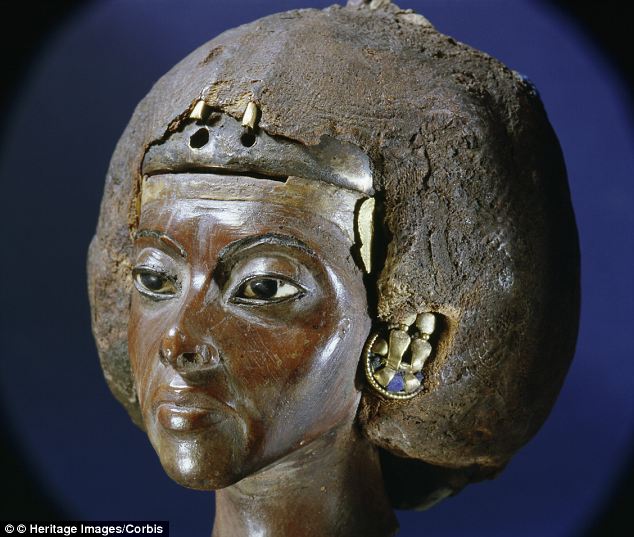
Queen
Tiye
Notes
*1 Kheny
A sandstone quarry situated where the
Nile cliffs
are at their narrowest. It is forty miles north of Aswan, between Edfu
and Kom Ombo. The name means “the Place of
Rowing”. It is now called Gebel el-Silsila,
“Chain of
Mountains”.
Back to text
*2 Sem-priests
The sem-priests took charge of the
arrangement of
funerals, from initial mummification through to the
interment.
The sem-priest officiating at the burial wore a leopard-skin and
normally carried out the ceremony of the Opening of the Mouth which
allowed the deceased to see, hear, breathe and speak in the
Afterlife. The eldest son and successor of the deceased seems
often to have assumed the role of sem-priest, and, in the case of the
kings, this confirmed his right to succeed.
Back to text
*3 Ka
The singular is ka, the plural
kau. The ka is
a form of soul, the vital essence which left the body on
death.
It had to be sustained with food and drink, the offerings left at or
stored in the tomb of the deceased.
Back to text
*4 365 days in the year
The Egyptians were the first to
calculate the length
of the year at 360 days, which gave us the 360 degrees of the
circle. The year consisted of 12 months of 30 days each, to
which
they later added 5 extra called the dead days.
Back to text