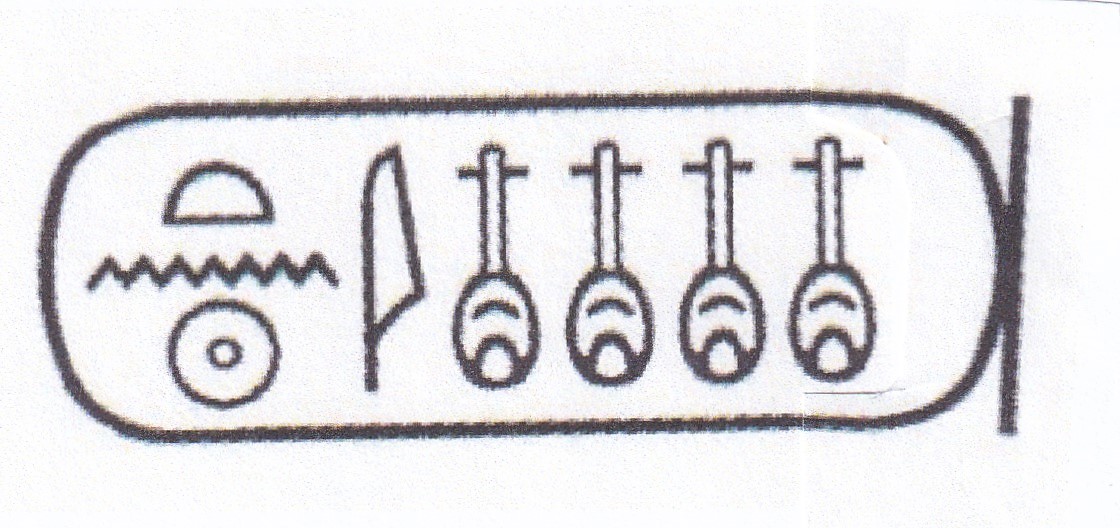
Neferneferuaten:
Glorious is the Splendour
of the Sun
 By Robin Gordon
 Auksford 2024
©
Copyright
Robin Gordon, 2024
PART
III:
NEFERKHEPERURE-
WAENRE
14.
Jubilee, Plague and Plotting
Auksford 2024
©
Copyright
Robin Gordon, 2024
PART
III:
NEFERKHEPERURE-
WAENRE
14.
Jubilee, Plague and Plotting
Flatterers danced their dance around the King, admired him
and
praised him, made sure he remembered their loyalty and would always
reward them. Ay was at his ear too, to remind him that the
priests of Amun were his enemies, constantly plotting against him, and
needing to be watched and constantly weakened. Ay also had
the
ear of the First Prophet of Amun, telling him that the King was
planning to destroy the priesthood and that Ay was doing his best to
pacify the King’s irrational hatred of the god who had
liberated
Kemet and made its Kings powerful, the god to whom the Kings owed
everything they had, the god whom they ought to thank and worship, the
god on whom their kingship depended. He would then return to
Akhetaten and tell the King that the priests had said that the King
depended on the god for his kingship and that, if the god chose, the
priests could remove the King and replace him with a prince more loyal
to Amun.
In the City of the Rising Sun the courtiers, especially those
friendly to Lord Ay, lived high on the hog. Beef and wine
came to
them in large quantities, while the labourers, who toiled to build the
King’s great new city, were undernourished and plagued by
disease. That so many of them died young was unknown to the
King,
secure in his circle of admiring sycophants. If he ever heard
that his name was cursed by the common people, he knew, for Ay would
tell him, that they were merely malcontents who should be punished for
their ingratitude towards a monarch who fed them so generously.
Meanwhile throughout the Two Lands the King’s
Commissioners, mercenary soldiers from Kush and even from the desert
tribes, roamed from temple to temple, demanding gold for the King and
occasionally defacing inscriptions showing the name of Amun, if they
recognised it, just to show what they could do if they chose.
The temple priests were cowed into handing over their
treasures,
and wealth flowed into the King’s coffers in
Akhetaten. It
was a clear confirmation that Ay was right: the priests had been
depriving the King of his due, but now that his finances were back on
an even keel, now that his treasury overflowed with gold, silver and
precious stones, his barns were stocked with wheat, and his stockyards
filled with cattle, preparations could begin for the great jubilee.
There were, of course, annoying matters of foreign policy
that
were brought to the King’s notice: appeals for help from
Rib-Addi, the vassal-king of Gubla, accusations against his neighbour,
Abdi-Ashirta, the ruler of Amurru, news that that neighbour had brought
about the death of the faithful Rib-Addi; and also requests from
Assur-Uballit of Assyria to be allowed to send envoys as a Great King,
and counter-requests from Burnaburiash of Babylon who claimed that
Assur-Uballit was his vassal and could not be counted as a Great
King. Akhenaten ignored the requests for help, and, almost
casually, accepted the envoys from Assyria. Foreign affairs
were
of little consequence to him. The lesser breeds might fight
it
out among themselves as far as he was concerned.
It was a different matter when the tribesmen of Kush revolted
against their overlords. Kush was almost part of Kemet and
the
source of most of its gold. His viceroy in Kush was
instructed to
put down the rebellion, which he did quickly and efficiently.
In the meantime the King’s life continued as
before.
He basked in the approval of his god. He enjoyed the flattery
of
his courtiers and the love of his wives and children. Queen
Neferneferuaten-Nefertiti bore him two more daughters, Neferneferure
and Setepenre. They were beautiful babies, and they and his
other
children flourished. Preparations continued apace for the
great
jubilee to take place in year 12 of his reign.
When year 12 came the jubilee was a triumph. Envoys
from
all over the world came to Akhetaten bringing rich gifts from their
masters. From Babylon, from Assyria from the coasts of the
Great
Green Sea and from the islands they came. Legates from Hatti
and
Mitanni, and even Libya and Punt,*1
crowded into the City of the
Horizon of the Rising Sun, bringing praises and presents from their
lords. The King of the island of Alashiya*2
even sent apologies
that his gift of copper was less than he had hoped to send, because
there was plague in his kingdom.
For little Prince Tutankhaten there were new excitements each
day. His mother told him that his father was the greatest
king in
the whole world and that all the other kings, the greater kings and the
lesser, were sending him tribute to celebrate his
achievements.
The Queen herself, Neferneferuaten-Nefertiti, told him that one day he
would be King of the Two lands, the greatest king in the whole world
and the other kings would flock to his city to bring him
tribute.
Best of all, his beloved grandmother, Queen Tiye, who spent much of her
time in her old palace near the city of Waset, came to stay in
Akhetaten. She told him that his grandfather, King
Nebmaatre-Amenhotep, had been the greatest of all the great kings of
Kemet, who were the richest, most enlightened and greatest Kings in the
world, that his father now occupied the throne of Kemet, and that one
day he too would be the greatest of the great kings and all the other
rulers would bring him their tribute.
She told him
too that part of the celebration was for him. King
Neferkheperure-Waenre-Akhenaten had not only completed his new city and
rebuilt its main temples and palaces with stone, which would last for
ever, but he had been blessed with an heir, Prince Tutankhaten, and the
heir had survived the dangerous first three years of early childhood,
so the great dynasty that now ruled in Kemet would go on for ever and
ever.
Like all
festivals in Kemet, the grand jubilee of year twelve went on for
several weeks. Gifts of all sorts were presented to the King,
sometimes in his palace in the Central City, sometimes in huge marquees
erected in the desert. Gifts came from the people of the Two
Lands, from Kush, from all the Great Kings of the world, and from the
lesser kings and princes. Gold and jewels were piled high in
the
storerooms. Giraffes and other exotic animals were paraded
before
the King and his court and that was the part Tutankhaten liked
best. Slaves were paraded, soldiers marched and saluted, and
everything was centred around the Great King Neferkheperure-Waenre and
his family.
The King
himself also gave gifts, as he could well afford to from the riches
bestowed on him. Leading courtiers were given the famous
collars
known as the Gold of Honour, and Ay made sure that he was one of the
recipients, for gifts from the King increased his status, which pleased
him greatly. Men whom the King honoured had power and
influence,
and Ay could never have enough of those.
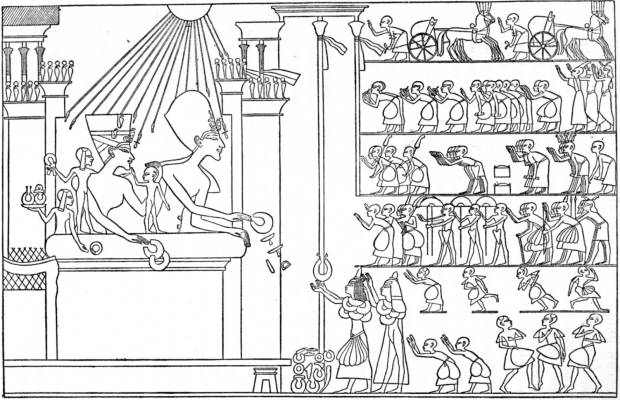
Presentation
of the Gold of Honour
Throughout the two lands the people celebrated.
They had
been denied the annual Opet-festival, when the proscribed god Amun was
carried in his sacred barque to the temple of his wife Mut to renew his
fertility and that of the land of Kemet while the waters of the River
spread life-giving silt over the fertile fields, so perhaps they were
all the more eager to celebrate the King’s jubilee with days
of
feasting and drunkenness. That the feasts could no longer be
justified as worship of the cow-goddess Hwt-Hor scarcely
mattered. Good times were here again, even if only for a
while.
The builders of Akhetaten did not celebrate. They
rested. You don’t celebrate when you have had to
toil for
months on inadequate rations, but the builders were all hidden way in
their own houses in their village and the King had no knowledge of
their plight.
He was happy. Precious gifts poured into his
treasury,
adulation surrounded him, his people adored him, the kings and princes
of the world did him homage, even the Great Kings, of whom he was
acknowledged to be the greatest, bowed before him. It was the
highest point of his reign. What could possibly detract in
even
the slightest way from his happiness and glory?
The greatest
danger of a major jubilee, with visitors and envoys from all over the
world, was that plague might be imported. A celebration on
the
scale of the heb-sed of year twelve was almost bound to bring
disease. Plague spread through Akhetaten sparing neither the
rich
nor the poor. Not even the Royal Family was immune.
The
King’s youngest daughters, Neferneferure and Setepenre both
fell
ill and lay swollen and shivering in their beds. Their
illness
was a deadly reminder of the plague that had followed the great jubilee
to celebrate the thirtieth year of King Nebmaatre-Amenhotep, when the
Crown Prince himself had died.
The King prayed
to the Aten, and his mother quietly prayed to Amun, Hwt-Hor, Sekhmet,
Taweret and Bes. Queen Neferneferuaten-Nefertiti prayed to
all
these, and to Ḥepa, the consort of the great storm-god who ruled her
homeland, and to Shaushka, his sister. Nothing was of any
avail. The little girls grew sicker and sicker until they
died,
and already the King’s second daughter, Meketaten, had caught
the
plague. She did not linger long.
All three girls
were buried in the side chambers of the King’s great tomb in
the
Royal Wadi, with new ceremonies devised by the King himself.
The
ka of Meketaten was portrayed as a new-born baby to symbolise her
rebirth into the afterlife of eternity. Akhenaten was
stricken
with grief. His daughter, despite her name, had not been
protected by the Aten. Three of his children were
dead.
Would others follow? Was his heir, Prince Tutankhaten, safe?
It seemed that
he was. The plague died away, but as always with plague,
pockets
of disease remained, ready to sweep across the land and kill again.
The deaths of his daughters threw Akhenaten into
depression. He began to feel that the millions of years of
his
reign, as guaranteed by his father the Aten, might already be drawing
to a close. Like his father before him he gave less and less
attention to matters of state and relied ever more on his Queen to
ensure that his ministers carried out his will.
Ay felt that this was most unfair. The King should
rely on
his faithful counsellor, not on a woman, however beautiful she might
be. He brooded long and hard on the unfairness of life and
the
injustice of a King who failed to reward the loyal service of his most
faithful friend. Although fresh waves of plague swept across
Kemet, no further deaths occurred in the Royal Family, and the hated
usurper, who occupied Ay’s rightful place as the
King’s
adviser, seemed to be even more elegant and beautiful than
ever.
As Fan-Bearer Ay still retained access to King Honky and knew of all
his decisions and policies, information that he passed on to the First
Prophet of Amun whenever it was in his own interest to do so, but that
Woman had private access to the King, even in his own bedchamber, and
she could exercise her baleful influence all day and all
night.
She, like the old Queen Mother, who, he thought, should have had the
decency to die years ago, seemed intent on softening the
King’s
religious policies, on making peace with Amun, leaving no place for his
own intrigues.
He had been obstructed by the royal women from the
start.
King Fatso should have made
him his designated heir when Prince
Djehutymose died instead of letting the crown pass to the useless
Prince Honky. He’d have been sure of that if it
hadn’t been for Queen Tiye. Then Tiye and that foreign girl
had got together, always plotting against him and accusing him to the
King. Even when he did manage to get King Honky into a
suitably
irritated mood that he might have been able to use, that Monkey-girl,
his favourite sister, would calm him down again, and now she had given
him an heir. Every one of his carefully crafted plans had
come to
nothing, all because of these women.
What a way to
treat a faithful counsellor! It almost justified plotting to
kill
the King and that Woman
even if the King and his chief consort were, by
virtue of their anointed status as divine monarchs, in effect gods.
But even if he dared, and his protégé
Nakhtmin
would have to be the one to carry out the deed, the King and Queen were
always surrounded by secretaries, ministers, courtiers, security men,
generals and other sycophants and flatterers. Even a
faithful,
loyal and totally trustworthy counsellor and friend like Ay could
scarcely ever meet with them alone, so there was no chance for Nakhtmin
to get at them. Queen Tiye, at least, now spent most of her
time
at the old palace near Waset, but she was always popping back and
forward and bringing King Honky news that contradicted Ay’s
own
faithful reports.
Kiya
was the
only one within reach. Getting rid of Kiya might mean the
King
would be less stable and more open to the influence of his loyal
friend, but that woman would still be there to interfere …
unless …
More thought was needed. Ay then thought,
considered, pondered, plotted – and sent for Nakhtmin.
He explained to Nakhtmin the situation as he saw it, how the
King’s most faithful, loyal and trustworthy counsellor and
friend
had been pushed aside by the malign influence of certain female members
of the King’s household and denied the honours and gratitude
to
which he was justly entitled. It was the King’s
duty to
uphold maat,
truth, justice and the proper order of the world, but the
King had failed, the King had committed grave and serious injustice in
his treatment of Ay. If maat
were to be restored the King must be
freed from the influence of his female relatives, so that Ay could take
his rightful place and be in a position to reward his own most faithful
supporter, Nakhtmin.
“There is only one
course of action
open to
us,” said
Ay. “We must strike at the only one of
those women that we
can reach – Kiya.
What would you say to
killing her?”
“Oh, yes,” grated Nakhtmin.
“I’d make short work of her with my
sword.”
“No!”
said Ay. “You will have to use a cudgel.”
“That’s not a soldier’s
weapon.”
“Mnnngh,
exactly. We don’t want it to look as
if she has been killed by a
soldier. I’m going to send one
of my
servants to tell Kiya that one of
Nefertiti’s secretaries
wants to talk to
her in the garden, and then to tell him that Kiya has
asked him to
come to the garden. As soon as Kiya appears you
must
hit her across
the head with
your cudgel, then when Nefertiti’s
man comes on
the scene you must kill
him with your sword.
Put the
cudgel in
his hand, and then
we’ll raise the alarm.
We’ll tell everyone
that we heard screams and found
Nefertiti’s
secretary assaulting poor
Kiya. You rushed in
to defend
her and killed
her attacker, but it was too late.
Poor
Kiya was dead.
After that I’ll make Honky believe that
Nefertiti
sent her servant to
kill Kiya, so that
way we’ll get
rid of both
of them, and, with
my dear sister out of the
way in Waset,
I’ll soon
be the only
person in
the whole of
Kemet that
the King
can trust.”
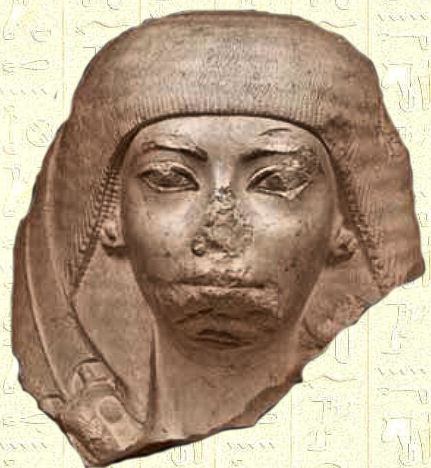
Nakhtmin
Notes
*1 Punt
A land rich in gold, ebony, ivory and
resins like
frankincense. It is thought to have been situated on the horn
of
Africa in the region of Somalia.
Back to text
*2 Alashiya
Cyprus.
Back to text