Neferneferuaten:
Glorious is the Splendour
of the Sun
 By Robin Gordon
 Auksford 2024
©
Copyright
Robin
Gordon, 2024
PART VII:
DJESERKHEPERURE-
SETEPENRE
29.
Restoration
Auksford 2024
©
Copyright
Robin
Gordon, 2024
PART VII:
DJESERKHEPERURE-
SETEPENRE
29.
Restoration
As luck would have had it the time of Ay’s decline
and
death and the prescribed seventy days of mourning brought the year
round almost to the Opet festival again. Horemheb’s
coronation and the associated festivities could thus continue through
the Opet festival, giving the people of Kemet weeks of celebration.
Proclamations were read throughout the land informing the
population that Horemheb had been chosen from the days of his infancy
by Hor, the god favoured and especially worshipped in his home town of
Hansu, to be King, and that Hor had led him before Amun, the King of
the gods, who had joyfully recognised him as the rightful successor to
the throne and crowned him as heir to the throne in the presence of the
other gods and their priests.
By
this news
the people were made aware that the new King would worship the gods who
had made the Two Lands great and prosperous, and that, despite that
fact that Horemheb had served the Akhetaten monarchs as general, now
that he was King, the neglect of the gods was over. The King
would worship them as all the earlier Kings had done, and Kemet would
be rewarded by the renewal of their favour.
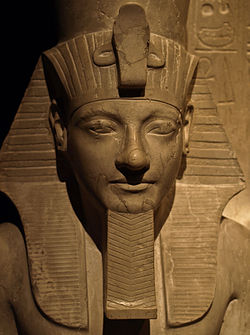
The same proclamation was then carved on the coronation
statue of the King and queen Mutnodjmet.*1
Further proclamations recognised the terrible state into
which
the country had fallen and announced severe penalties for those
responsible. Soldiers who stole hides from farmers to make
leather shields, leaving the farmers with no proof that cattle had died
or been slaughtered, tax collectors who preyed on the farmers and
demanded payment as if the farmer still had as many cattle as he had
the previous year, bandits who ambushed boats on the river and stole
the goods collected as taxes for the government, or even stole the
boats, might have their noses cut off and be sent into exile at Sile on
the north-eastern frontier, or they might suffer one hundred lashes and
five open wounds. On the other hand, peasants who could not
pay
their taxes because they had been robbed of cattle or hides, would no
longer be punished, for their intentions were recognised as good and
their failure as not their fault.
This gave the farmers more reason than ever to rejoice at the
coronation of the new King.
The laws were put into practice at once, even before they had
been carved on one of the pylons at Ipet-sut. Ay’s
tax-gatherers quickly saw that their time was over and fled back to
their home villages to lie low or even left Kemet altogether.
Maya was now properly in control of the Treasury and the collection of
taxes, and he was as determined as Horemheb that justice should
prevail. Throughout the land his commissioners re-assessed
the
wealth of landowners, farmers and peasants, and ensured that the taxes
claimed from them were fair and matched their ability to pay.
The army was now divided into two divisions, each with its
own
commander owing obedience to the King as commander in chief.
One
division was stationed in the south to keep watch on any possible
revolt in Kush, and the other in the north to defend the country
against any incursion from Hatti, and, eventually, to re-establish
control over the lands east of the Great Green Sea.
The faithful General Paramessu was made vizier of the
southern
half of the Black Land, while the main administrative centre was at
Men-Nefer, on the boundary between the Two Lands. The King,
however, was not confined to his capital city. He and his
entourage moved around the Two Lands, ensuring that the new laws were
carried out faithfully. He reorganised temples and gave them
new
priests chosen from among officers retiring from active service in the
army. This ensured efficient running of the temples, which
were
not just run for the benefit of their priests but, until the reign of
Akhenaten had been important elements in the economic organisation of
the country and sources of help for the people when times were
hard. They would now take up those roles again.
The King also rebuilt and extended temples that had fallen
into
dilapidation and provided them with new statues of the gods that were
more beautiful than those they replaced.
Under his rule the farmers found that extra profits made from
working harder were no longer stolen from them. Harder work,
bigger crops, more cattle, all made for a more secure and comfortable
life. Artisans too worked harder, no longer fearing that
additional pottery, jewellery or other artefacts would simply add to
the loot stolen by bogus tax-collectors. Prosperity returned
to
Kemet, and trade with other countries, which had lapsed under the
previous reigns, was re-established. The gods, it was clear,
again smiled on the Black Land and granted life, prosperity and health
to its King and its people.
Horemheb had vowed that, when he became King, he would turf
Ay
out of the tomb he had stolen from Tutankhamun, continue the
excavations to enlarge it, and re-inter the late boy King, his parents
and his beloved grandmother Queen Tiye in a fitting resting place with
all due ceremony.
Removing Ay was rapidly achieved. The usurping king
was
reburied in a smallish tomb in an area reserved for non-royal
noblemen. His name and his image were deleted from the tomb
he
had stolen, an architect designed the enlargements that were needed,
and workmen were directed to begin extending the tomb.
It was then that the Valley of the Kings was hit by a flash
flood. When the water cleared the floor of the valley was
covered
by a layer of mud and rubble several cubits thick, completely
concealing the entrances to the tombs where Tutankhamun and his parents
lay. Clearing the deposit would be a major task, and it
would, in
any case, have to wait until the mud dried out or the whole layer would
be too unstable. Why had the gods permitted such a thing to
happen?
The First Prophet of Amun and the Greatest of Seers were
agreed. The gods had sent the flood because they wished the
Enemy
to be forgotten forever, he and all his relations. As far as
the
gods were concerned King Djeserkheperure-Setepenre-Horemheb was the
direct successor of King Nebmaatre-Amenhotep, and the time of the great
heresy was cast away as if it had never occurred. It would be
wrong, it would be against the will of the gods, it would be an offense
against maat
to attempt to disinter what the gods had so determinedly
buried.
Horemheb had to agree. It was a pity about the
boy.
If he had lived he might have re-established maat, and it was a
pity
about Queen Tiye, who had always done her best for Kemet, but they were
stuck between the Heretic and the Hypocrite, both part of the time of
trouble. So that was why the gods had hidden them all
forever. He abandoned the tomb he had intended for
Tutankhamun
and gave orders that the building of his own should start.
His architect had chosen a suitable site and the work of
excavation had begun. Horemheb and his advisers knew that his
reign signified a new beginning for the Two Lands, and therefore they
thought that his tomb should be in some ways different from those of
the older traditions. It was much straighter that the
pre-heretic
tombs, its decoration was not to be simple wall-paintings but painted
relief carvings, and, after consultation with the priests, the theme
was to be different. It was the Greatest of Seers who
suggested
that instead of the traditional Amduat, The Book of What is in the
Underworld, the King’s tomb should contain
illustrations from The
Book of Gates.
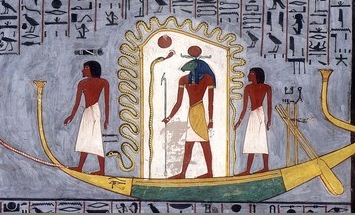
The
Book of Gates: the Barque of Re
Both books
narrated the voyage of the Sun-God, Re, through the Underworld, divided
into the twelve hours of darkness, but The Book of Gates
concentrated
on the twelve gates, guarded by fearsome serpents, and the necessity of
knowing their names and the correct spells to allow the barque of Re to
pass. It was, of course, King
Djeserkheperure-Setepenre-Horemheb’s royal duty to defend the
Sun-God, assist him to pass through the gates, and ensure that daylight
would return to the world again.
Horemheb had intended to build himself a funerary temple,
but,
given the still shaky, though improving, state of the economy, and
given that the gods had clearly signalled that all the monarchs
associated with the Great Heresy introduced by the Enemy, namely
Akhenaten himself, his unfortunate mother, Queen Tiye, his immediate
successor, Smenkhkare, his poor son, Tutankhamun, and the sniggering
hypocrite, Ay, were all consigned to be forgotten, what better solution
could there be than to take over the temple originally intended for
Tutankhamun and which Ay had stolen for his own use?
Ay’s
cartouches could easily and cheaply be replaced by those of the new
King. And statues could be re-carved or simply relabelled, as was often
done when one King succeeded another. Horemheb himself had
much
more important things to do than concentrate on his own monuments.
In year seven he had to pay some attention to his
tomb. It
was reported to him that work was progressing much too
slowly.
The personnel of the workman’s village, those responsible for
work in the royal tombs, were not skilled in carving. They
were
well able to excavate complex tombs and to smooth the walls.
They
included skilled plasterers and painters, but not sculptors.
Statues were always made elsewhere and brought in. Horemheb
had
to give orders to recruit sculptors and to enlarge the village to
accommodate them, and, of course, even in a well-run country like
Kemet, there was delay after delay.
In year 9 Maya died. Horemheb had lost one of his
closest
friends and allies and the man responsible for returning the countries
taxation system to justice and fairness, but by this time the King and
his Treasurer had been so successful in their reforms that
Maya’s
successor could take over without any problems.
Maya
The economy continued to improve. Trade with Gubla
was well
established and the famous cypress wood was available in
Kemet.
Trade with Alashiya had been restored, and copper was freely available
so that bronze could be made in quantity, and opium too was available
for those who were ill and had insufferable pain. Recent
expeditions had even re-established trade with Punt, so that the
incense so beloved of the gods was again imported, together with other
products from the south. Kemet was again as wealthy as it had
been under the great King Nebmaatre-Amenhotep, and the people know that
it was all achieved by King Djeserkheperure-Setepenre-Horemheb, the
true upholder of maat.
Only one thing troubled the King. The years had
gone by,
but still he had no son and heir to succeed him. In order
that
the Two Lands should continue in peace and prosperity after he had
passed on to the Afterlife, Horemheb made General Paramessu Hereditary
Prince and Deputy to the King throughout the Two Lands.
Paramessu
was now heir presumptive. If the King still had no son at the
time of his death, Paramessu would become King, and he already had a
son, Seti, who had proved himself a capable commander in his army
career and an excellent administrator. Seti himself already
had a
son, a very promising youth, and two daughters, so the succession was
assure for at least two generations, with every possibility that the
new royal family would go on for several more.*2
In Year 12 Queen Mutnodjmet was pregnant.*3
Prayers for
her safe delivery and for a healthy child were offered to Horus, Amun,
Djehuty, and, of course, Bes and Taweret. All were
unavailing. In year 13 mother and child both died when the
birth
was due.
Horemheb continued to reign, assisted by Paramessu, and when
he
died, as all Kings must, Paramessu succeeded to the throne.
Horemheb died knowing that he had achieved all he had set out
to
do, that Kemet was as prosperous and influential as it had been before
the Great Heresy, that it was once more one of the Great
Powers.
He knew that he would join the Sun-God, Re, in the solar barque, defend
him from the serpents of chaos and ensure that sunrise would come
again, and that he would relax in the Field of Reeds under the blessing
of Usír. He knew that the people of Kemet regarded
him as
much a saviour of their country as King Neb-pehty-re Ahmose
who
had driven out the Foreign Princes who had taken over so much of the
Black Land, that he was regarded as a great King who had brought peace
and prosperity like King Nebmaatre-Amenhotep, and that the new royal
family regarded him as their founder and would maintain his cult with
prayers and offerings at his temple. He could die content.
Notes
*1 Mutnodjmet
Some Egyptologists believe that Mutnodjmet was the sister of Nefertiti
though Nefertiti’s companion’s name is now read as
Mutbenret. They use the similarity of names to build a whole
fabrication of alleged family relationships, proving, to their own
satisfaction that Nefertiti was the daughter of Ay and that Ay
therefore had a right to the throne as the sole surviving member of the
royal family. There is no evidence for any of this, and, even
if
there were, being the father of a king’s wife does not give
anyone a claim on the crown.
Back
to text
*2
Paramessu and his son and grandson
Paramessu reigned for only about a year as Rameses I. He was
succeeded by his son, Seti I, who was followed by his son, Rameses II.
Back
to text
*3
Mutnodjmet’s pregnancy
By year 13 of Horemheb’s reign, Mutbenret, if still alive,
would
most probably have been in her late sixties.
Back
to text